
“‘You yourselves have seen what I did to the Egyptians, and how I bore you on eagles’ wings and brought you to myself. Now therefore, if you will indeed obey my voice and keep my covenant, you shall be my treasured possession among all peoples, for all the earth is mine; and you shall be to me a kingdom of priests and a holy nation.’ These are the words that you shall speak to the people of Israel.”” (Exodus 19:4–6, ESV)
God spoke these words to Israel after He had formed Israel into His people and guided them out of Egypt and to His mountain. They were to be His people, He would be their God. However, note God’s instructions in vss. 10-13 where Moses was warned that no one was to approach or touch the mountain, lest they perish! The Point: Israel was unfit to be in God’s presence. Chapters 20-24 form the basis of Israel’s covenant with God as the book of the covenant is read to the elders of the people, they swear fidelity, and sacrifices are made ratifying the covenant with their blood (Exodus 24.3-8). Significantly, it was immediately following this scene that Moses received instructions for God’s sanctuary, a place “that I may dwell in their midst” (Exodus 25.8).
The Tabernacle
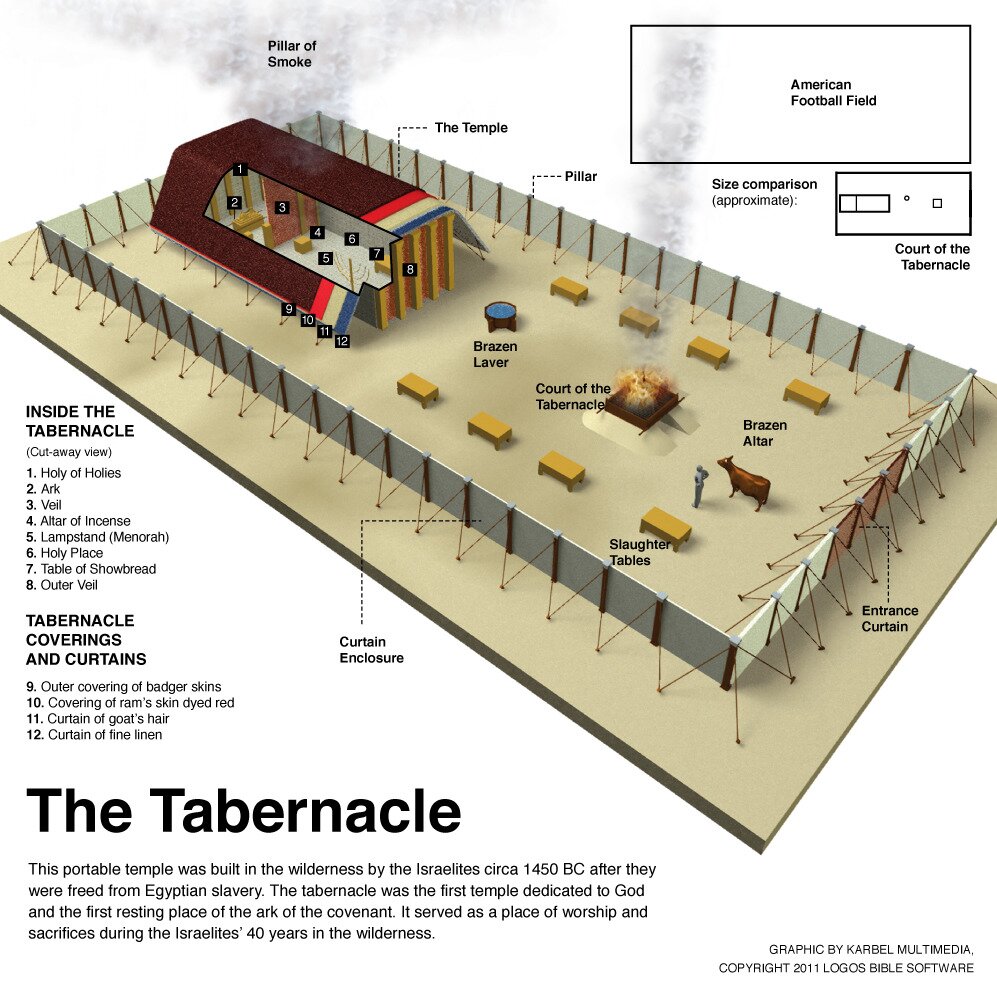
Exodus 25-31 record the detailed instructions God gave Moses regarding the construction of His sanctuary. If you’ve not read these chapters in a while, I encourage you to do so. Take note of these features of the tabernacle that would allow God to dwell in the midst of His people.
- The tabernacle would be made from the finest materials available. Significantly while the tabernacle was made from physical materials, those materials were contributed by the people (Exodus 25.1-7).
- The tabernacle must be constructed by God’s exact specifications (Exodus 25.8-9).
- The articles in the tabernacle would represent both God (the ark of the covenant, Exodus 25.10-22) and the people (the table of bread, Exodus 25.23-30; Leviticus 24.5-6).
- The tabernacle visually represented the separation of God and the people (Exodus 26).
- The tabernacle would be where necessary sacrifices were made for God’s presence to remain with the people (Exodus 27.1-8).
- A consecrated priesthood would represent the people before God (Exodus 28-29). Note how the garments of the priests visually represented their affiliation with God, using the same colors as the curtains of the tabernacle, while also bearing the names of the twelve tribes.
- The priesthood could only serve after washing with water (Exodus 30.21).
- The tabernacle, all of the articles within, and the priesthood must be anointed with a sacred oil (Exodus 30.22-33).
- Bezalel, the craftsmen intrusted with making the tabernacle, articles of the tabernacle and the priestly garments, was “filled… with the Spirit of God, with ability and intelligence, with knowledge and all craftsmanship” (Exodus 31.1-11; 35.30-35). The dwelling place of God would be crafted by one with His Spirit.
The Golden Calf
Sadly, immediately after God gave the instructions for the construction of His sanctuary, Israel broke it’s covenant with Jehovah by constructing a golden calf and worshipping it (Exodus 32). Moses’ throwing the tablets to the ground and breaking them (Exodus 32.19) wasn’t simply an act of righteous anger, it was symbolic of Israel’s forsaking their covenant with God! The Lord was ready to righteously punish the nation, but the intercession of Moses stayed God’s anger. While the Lord relented, note His words to Moses: “Go up to a land flowing with milk and honey; but I will not go up among you, lest I consume you on the way, for you are a stiff-necked people.” (Exodus 33:3, ESV)
Moses was terrified by the prospect and entreated the Lord: “If your presence will not go with me, do not bring us up from here. For how shall it be known that I have found favor in your sight, I and your people? Is it not in your going with us, so that we are distinct, I and your people, from every other people on the face of the earth?” (Exodus 33:15–16, ESV) The presence of God with His people, not the Law, would distinguish this people. However, His presence with them depended on fidelity to the covenant, the nation keeping His Law.
God’s Spirit With His People
Exodus 35-39 records the construction of the tabernacle while Israel was at Mt. Sinai. In Exodus 40 the tabernacle is erected and sanctified by blood sacrifice, all culminating with the glorious event recorded in vs. 34-35, “Then the cloud covered the tent of meeting, and the glory of the LORD filled the tabernacle. And Moses was not able to enter the tent of meeting because the cloud settled on it, and the glory of the LORD filled the tabernacle.” Significantly, these events are referred to in Isaiah 63.11-14 as the time when God “put in the midst of them his Holy Spirit”. God’s presence, the Holy Spirit, was now in a holy sanctuary among the people. His presence as symbolized by the ark of the covenant would lead the people into the promised land (Joshua 3:13-17) and give them victory over their enemies (cf. Joshua 6:6-11).
 Built By Him
Leave a comment