
Opening Questions:
- John 12 records Jesus’ “triumphal entry” into Jerusalem when the crowds heralded His arrival. However, the same crowd would demand His crucifixion. How does John 12 prepare us for the peoples’ rejection of Jesus?
- What questions do you have from the text?
The raising of Lazarus from the dead was a truly notable sign, but as we noticed this great work did not result in all people putting their faith in Jesus. The leaders of the Jews continued in their opposition (John 11.47-53) and while many of the people were looking for Jesus (John 11.55-56), we will soon discover that they were not willing to put their full faith in Him. Chapter 12 contains the account of Jesus’ “triumphal entry” into Jerusalem, the moment when it seemed like the people were ready to believe in Him. Yet, in the same chapter we find John describing the people as having blind eyes and hard hearts (vs. 40). What caused their blindness and hardened hearts?
Judas was hardened by sinful desire (vss. 1-8)
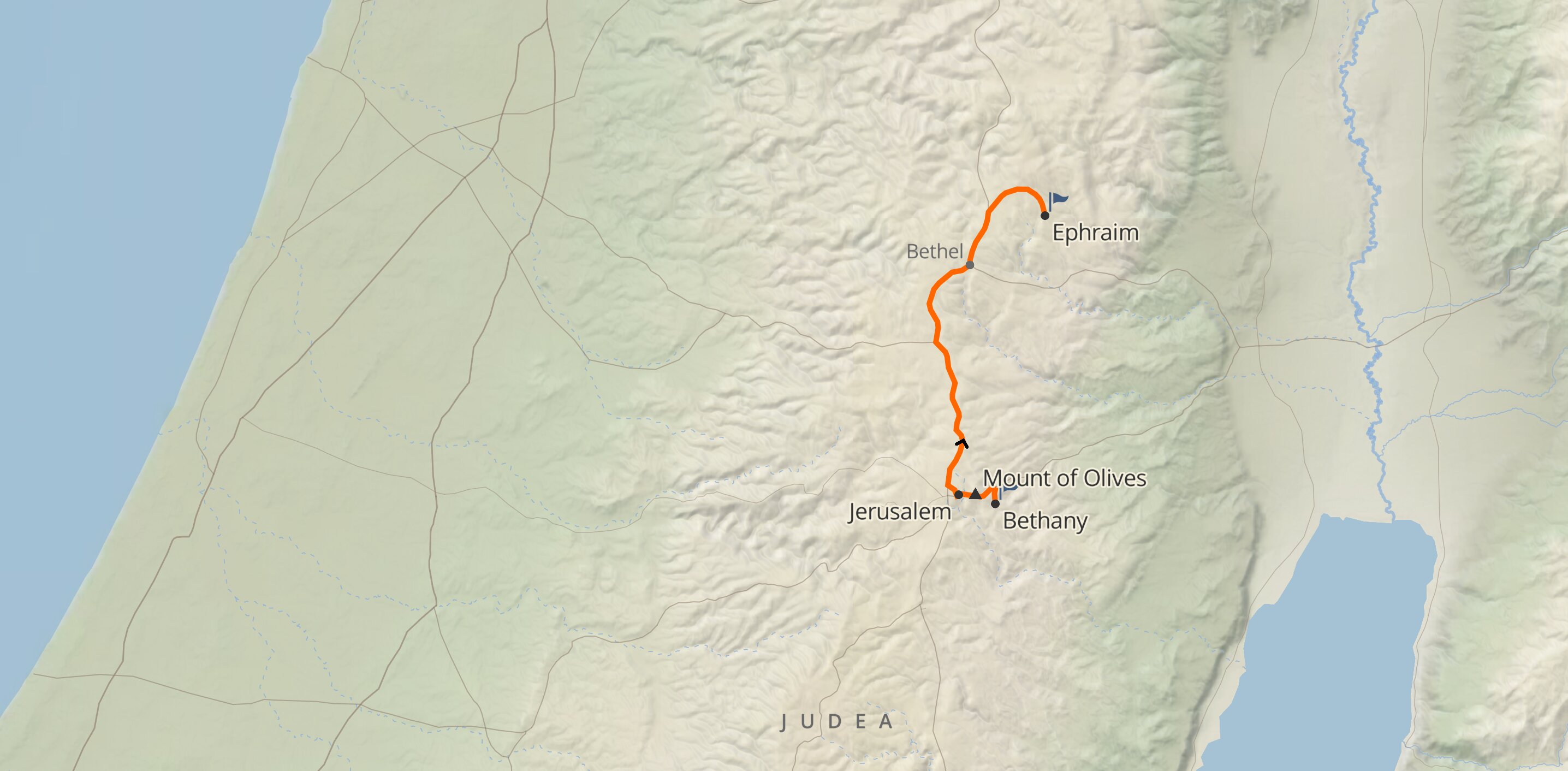
Following the raising of Lazarus from the dead, Jesus had withdrawn into a wilderness area near the city of Ephraim (John 11.54). However, the Passover was near and so was Jesus’ appointed hour. Six days before the Passover, Jesus returned to Bethany and attended a dinner given in His honor. Note that the parallel accounts in Matthew 26.6-13 and Mark 14.3-9 give additional details, including the fact that the dinner was held at the home of Simon the leper. However, the focus of the account is twofold. First, there is Mary’s act of devotion. Nard was a very expensive perfume, being extracted from a nepalese plant. She used a vast quantity as the Roman pound weighed approximately 11.5 pounds. Second, there is Judas’ reaction; while he feigned concern for the poor, he was motivated by greed. The seeds had been planted for Judas’ betrayal of Jesus.
Jesus’ words in vs. 7 deserves further consideration. While it may be that Mary understood better than other disciples that Jesus’ death was approaching, there is no clear evidence that Mary or anyone else understood before the cross that Jesus had to die. She meant this to be an act of costly, humble devotion, but like Caiaphas (11:49–52) she signaled more than she knew. In the culture of the day, it was not thought inappropriate to spend lavish sums at a funeral, including the cost of the perfumes that were designed to stifle the smell of decay (cf. notes on 11:39). But here was Mary, lavishly pouring out perfume on Jesus while he was yet alive. Small wonder Jesus sees it as a prefiguring of the anointing that Joseph of Arimathea and Nicodemus performed (19:38–42).
Jewish leaders were hardened by jealousy (vss. 9-11)
The chief priests are singled out for good reason. “The chief priests (mostly of the Sadducean party) had most to lose. They cooperated with the Romans in the administration of the province of Judea, and Jesus’ rapidly increasing fame was a growing threat to their position. Earlier the Sanhedrin, of which the chief priests were a most influential part, decided to kill Jesus to remove the threat. Now Lazarus too was adding to that threat, so the simple solution was to kill him as well” (Kruse, Colin G). The jealousy of the Pharisees is noted in vss. 18-19 as they incredulously note that “the world has gone after” Jesus.
People would be hardened by failed expectations (vss. 12-36)
Expectations had been building among the people, and when Jesus made His way to Jerusalem on the following day, there was an explosion of Messianic fervor. While the Law specified that palm branches were to be used in the Feast of Tabernacles (Leviticus 23.40), their significance had increased greatly during the intertestamental time. “When Simon the Maccabee drove the Syrian forces out of the Jerusalem citadel he was fêted with music and the waving of palm branches (cf. 1 Macc. 13:51, 141 BC), which had also been prominent at the rededication of the temple (2 Macc. 10:7, 164 BC)…Palms appear on the coins struck by the insurgents during the Jewish wars against Rome (AD 66–70, 132–135); indeed, the use of the palm as a symbol for Judea was sufficiently well established that the coins struck by the Romans to celebrate their victory also sported it. In short, waving of palm branches was no longer restrictively associated with Tabernacles. In this instance, it may well have signalled nationalist hope that a messianic liberator was arriving on the scene (cf. 6:14–15)” (Carson). The peoples’ Messianic hope was made clear in their cry: “Hosanna (literally ‘O Lord, Save’)! Blessed is He who come in the name of the Lord, even the King of Israel!” (John 12.14)
While Jesus’ riding into Jerusalem on donkey was the fulfilment of Scripture (Zechariah 9.9), this action was meant to subvert the peoples’ nationalistic hope. Zechariah 9.10 continues, “I will cut off the chariot from Ephraim and the war horse from Jerusalem; and the battle bow shall be cut off, and he shall speak peace to the nations; his rule shall be from sea to sea, and from the River to the ends of the earth.” By riding into Jerusalem on a donkey instead of a war horse, Jesus was once again emphasizing the spiritual nature of the Kingdom.
Jewish nationalistic expectations were subverted further when Greeks requested to see Jesus (vss. 20-21). Throughout John’s gospel Jesus had declared that His hour had not yet come (see John 2.4; 7.6,8,30; 8.20), but the Gentiles seeking Jesus signaled that “the hour has come for the Son of Man to be glorified” (vs. 23). Recall that in John 10.16 Jesus revealed, “And I have other sheep that are not of this fold. I must bring them also, and they will listen to my voice. So there will be one flock, one shepherd.” Now Jesus revealed that His death would result in much fruit; that anyone (Jew or Gentile) who would forsake their life for Him and follow wherever He leads, would be honored by the Father (vss. 24-26).
Finally, Messianic expectations were subverted by Jesus’ teachings about His death. Recall from John 10.17-18 that Jesus’ life was in His own control, but that He was committed to fulfilling the Father’s will. Thus, even though Jesus’ soul was troubled at the prospect of His death, His desire was that the Father’s name be glorified (vss. 27-28). In response, the Father declared that He had glorified His name (in Jesus’ ministry) and that He would glorify it again (in Jesus’ death and resurrection). The crowd was once again divided by what happened, but Jesus stated “This voice has come for your sake, not mine. Now is the judgment of this world; now will the ruler of this world be cast out. And I, when I am lifted up from the earth, will draw all people to myself” (vss. 30-32). The crowd understood that Jesus was speaking of His death, but that was contrary to their expectation of the Messiah (vs. 34). “Rather than replying directly to their quibble, Jesus directed them to open their hearts to believe the truth. The Light of the world would be with them only a few hours more, and if they continued their attitude of rejection they would remain in darkness and be lost” (Harkrider).
Some had misplaced affections (vss. 37-43)
It was clear that the crowd’s enthusiastic reception of Jesus had cooled. In vss. 37-41 John reveals how the people had failed to truly believe in Jesus. It wasn’t because they lacked opportunity, for Jesus had done many signs (vs. 37). Rather, the people had fulfilled the indictment of Isaiah 53.1; 6.9-10. The same sun which melts butter also hardens clay! God’s word is His power to salvation (cf. Rom. 1:16), and all who seek the truth can be saved (cf. John 7:17; 1 Tim. 2:4,6; Rev. 22:17). But those who of their own accord choose to reject the truth will be hardened by it and will accept a lie instead (cf. 2 Thess. 2:10-12)” (Harkrider).
Vss. 42-43 serves as an example of how the people were blinded to the truth. Again, it wasn’t that they couldn’t believe in Jesus, but rather their own desires prevented them. In this case, even some of the leaders were convinced by Jesus’ signs, but they refused to confess Him because “they loved the glory that comes from man more than the glory that comes from God.”
The urgency of belief (vss. 44-50)
This chapter has been filled with reasons why people did not believe in Jesus (greed, jealousy, unfulfilled expectations and misplaced affections), but concludes with the Lord urging all to put their faith in Him. To believe in Jesus is to believe in the Father (vs. 44-45; see John 1.14; 5.23; 7.16; 8.19, 42.). Believing in Jesus is how one escapes darkness and judgment (vss. 46-47; John 3.17). But to reject Jesus brings judgment because you rejects the Father’s words (vss. 48-50).
Notes from the text:
- Vs. 3: “The word for ‘pound’, litra, denotes a Roman pound weighing 11.5 ounces or 326 grams. That much perfume was a very large amount indeed. Nard is an extract from an aromatic Nepalese plant, Nardostachys jatamansi. The perfume was expensive because it was imported from a great distance, as well as having to be extracted from plant material. The process of extraction usually involved large amounts of plant material yielding only a little aromatic oil. Just how expensive this perfume was is revealed in 12:5. Anointing Jesus’ feet with so much expensive perfume was an act of great devotion” (Kruse, Colin G).
- Vs. 4: The parallel accounts in Matthew and Mark seem to indicate that after this incident Judas went away immediately and made his deal with the Jewish authorities to deliver up Jesus. Losing out on one source of sordid gain, he immediately went out and set up another.
- Vs. 28: see John 7.18; 11.4,40; 17.4.
- Vs. 31: Hebrews 2.14-15.
- Vs. 32: see John 3.14; 8.28.
- Vs. 34: Psalm 89.36; 110.4; Isaiah 9.7; Daniel 7.14. “The same sort of incredulity is found in the statement of Trypho the Jew to the Christian apologist Justin: ‘According to scripture the Son of man is to be full of honour and glory and establish the eternal kingdom (Dan. 7:13–14), but your so-called Christ was without honour or glory and was struck by the worst curse in the law of God by being crucified’ (Dialogue with Trypho xxxii.1)”
 Built By Him
Leave a comment