
Opening Questions:
- What do you learn about how believers can struggle with their faith?
- How did raising Lazarus from the dead glorify both Jesus and the Father?
- What questions do you have from the text?
One of the opening claims about Jesus was “In Him was life, and the life was the Light of men” (John 1.4). Throughout the gospel, Jesus amplified this claim in a variety of ways: He has/is the water of life (4.14; 7.37-38); He is the bread of life (6.48-51); He gives life abundantly to His sheep (10.10). But how do His claims stand in the face of death? John 11 provides an emphatic answer to that question.
Jesus had already promised that one day all the dead would rise (5.28-29), but in John 11.25-26 He claimed even greater power and authority over death. This victory over death is promised to those who believe in Him, yet the chapter records the doubts and disbelief of Jesus’ closest followers.
The Disciples Struggled To Believe (vss. 1-16)
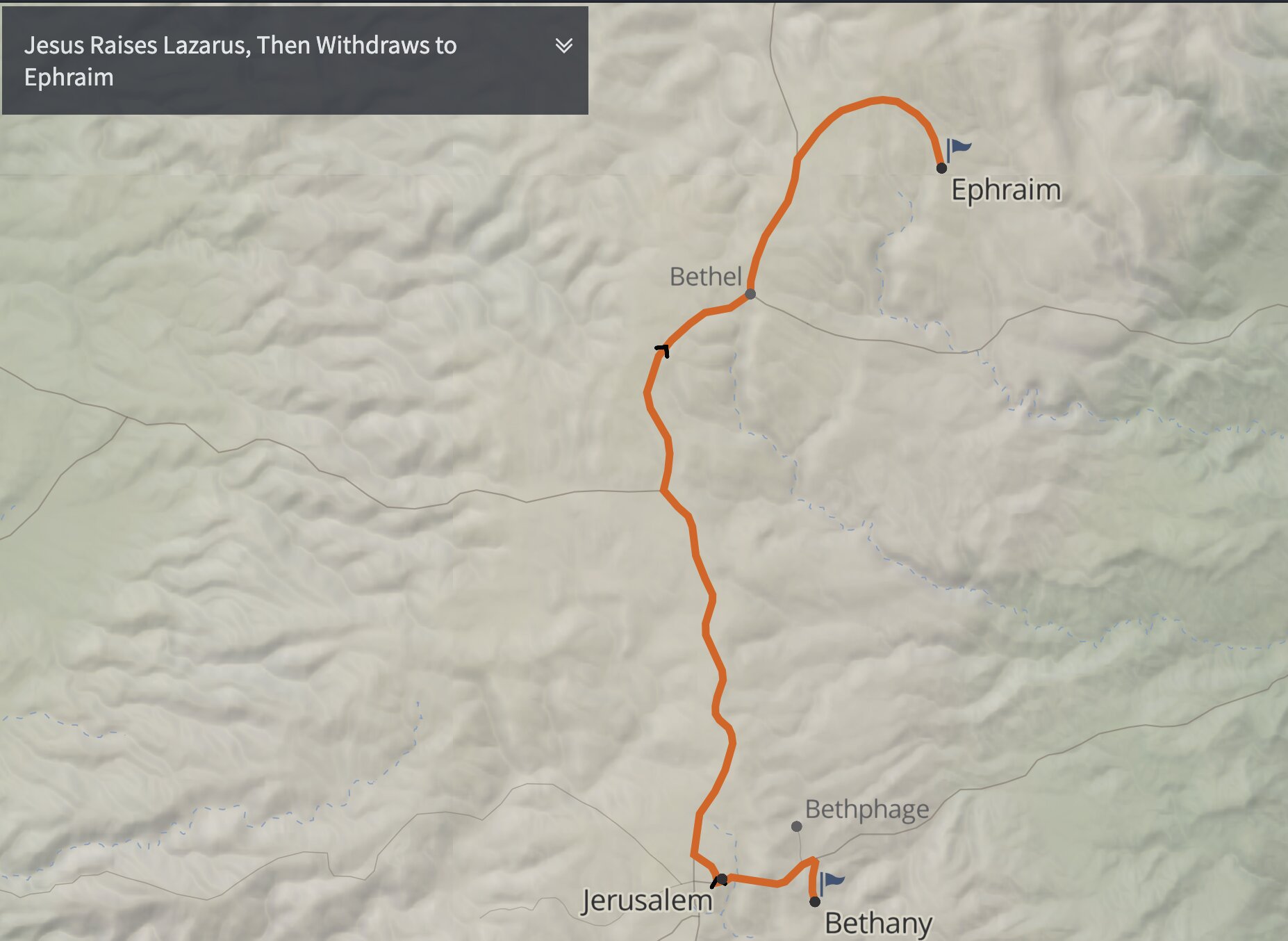
Jesus and His disciples had recently departed Jerusalem and withdrawn to the other side of the Jordan River because of the increased opposition of the Jews (10.39-40). Bethany was less than 2 miles from Jerusalem (vs. 18), so the disciples believed that Jesus travelling so close to Jerusalem would result in His death (vss. 8,16). Everything Jesus did in this section was meant to bolster their faith…
- He revealed that the result would be the glorification of God and His Son (vs. 4). Recall that it is in the Son that God’s glory is revealed (1.14) and His works were meant to glorify the Father (17.4). Jesus’ raising Lazarus from the dead would reveal the glory of the Father and would furnish His disciples with reason to believe (vs. 15).
- His reference to 12 hours in the day (vs. 9) would emphasize the importance of carrying on the Father’s work (see John 9.4-5). “The daylight period of his ministry may be far advanced, but it is wrong to quit before the twelve hours have been filled up. The time will come soon enough when he will not be able to work” (Carson).
- Saying that Lazarus is “asleep” in vs. 11 points to a deeper truth (see vss. 25-26). Of significance is the fact that Jesus calls Lazarus “our” friend, but “I go” to awake him. Only Jesus is the resurrection (vs. 25), only He could call Lazarus forth.
- Jesus’ delaying 2 days may have significance. Given that Lazarus was dead 4 days by the time Jesus arrived (vss. 17,39), an immediate departure would not have brought Jesus to Bethany in time. However, “From a slightly later date there are sources attesting the rabbinic belief that the soul hovers over the body of the deceased person for the first three days, ‘intending to re-enter it, but as soon as it sees its appearance change’, i.e. that decomposition has set in, it departs (Leviticus Rabbah [a rabbinical commentary] 18:1 [on Lv. 15:1];” (Carson).
Martha & Mary Struggled To Believe (vss. 17-27)
Martha possessed faith in Jesus (vss. 21-22) and the faith that her brother will rise on the last day (vs. 24). But did she believe that Jesus IS the resurrection and the life (vss. 25-26)? While her response would affirm Jesus’ words (only the Christ, the Son of God could be the resurrection and the life), she clearly did not fully comprehend Jesus’ claim (see vs. 39).
Mary also possessed faith in Jesus (vs. 32), but her faith did not go so far as to believe that Jesus offered immediate hope. She did not comprehend the full impact of Jesus being “the resurrection and the life”. This passage paints a picture of despair. All are weeping (vs. 33) and some seem to question why Jesus had not come before (vs. 37). None believe Jesus could or would do anything after Lazarus’ death!
This backdrop must shape our understanding of Jesus’ actions in vss. 33-35:
- The phrase “deeply moved” in vss. 33,38 typically suggests anger and indignation (see Mark 14.5). “It is lexically inexcusable to reduce this emotional upset to the effects of empathy, grief, pain or the like.” (Carson).
- Note the NLT reading: “When Jesus saw her weeping and saw the other people wailing with her, a deep anger welled up within him, and he was deeply troubled.”
Thus, Jesus’ weeping in vs. 35 was not mere sympathy, but a deep emotional response to the unbelief surrounding Him.
Jesus Proved His Mastery Over Death (vss. 38-44)
Jesus’ words to Martha in vs. 40 form a connection between vs 4 and vss. 25-26: raising the dead to life was the means by which the glory of God was manifest in the Son. Furthermore, Jesus’ prayer in vss. 41-42 amplified the truth already stated in John 5.19-21: what the Son does is because the Father both hears Him and is with Him. And Jesus’ desire was that those who witnessed this marvelous act would know this!
Jesus’ command of Lazarus to “come forth” was proof that the dead give heed to His voice (John 5.25,28-29). “Though it is not John’s point, it has often been remarked that the authority of Jesus is so great that, had he not specified Lazarus, all the tombs would have given up their dead to resurrection life” (Carson). Furthermore, it furnished proof of Jesus being “the resurrection and the life” and all that entails (vss. 25-26).
Finally, a contrast might be made between the resurrection of Lazarus and the resurrection of Jesus (see 20.7). “Lazarus was called to a restoration of mortal life. Small wonder he groped blindly for the exit, and needed to be released from the graveclothes that bound him. Jesus rose with what Paul calls ‘a spiritual body’ (1 Cor. 15), leaving the graveclothes behind, materializing in closed rooms. Though his resurrected body bore the marks of his five wounds and was capable of eating and of being touched, it was raised with the power of endless life, the firstfruits of the resurrection at the end. Those who hear Jesus’ shout on the last day will participate in his resurrection; the resurrection of Lazarus, occurring before that of Jesus, could only be a pale anticipation of what was yet to come. It was, in fact, a ‘sign’… rightly the climactic sign” (Carson).
Jesus’ Mission To Give Life Resulted In His Death (vss. 45-57)
We have noted the increasing hostility of the Jewish leadership (5.16-18; 7.25,32; 8.59; 10.31,39). Chapter 11 began with the disciples reluctant to travel to Bethany which was so near to Jerusalem (vss.8,16) and concludes with the Jewish Council agreeing to put Jesus to death (vs. 53). Jesus’ travels to Bethany to restore life to Lazarus hastened His death. Jesus’ coming to the World to restore life brought about His death.
Fittingly, the chapter concludes with Jesus in Ephraim (~12 miles from Jerusalem) and the Passover drawing near. The people anticipated the arrival of Jesus and were aware that their leaders were seeking to kill Him.
 Built By Him
Leave a comment