
Opening Questions:
- Why do you think all four gospels include this miracle? What truth is this sign conveying about Jesus?
- Why do you think Jesus first asked His disciples about what should be done?
- What questions do you have from the text?
Setting of the Miracle (vs. 1-4)
It is significant that this is the only one of Jesus’ miracles (aside from the resurrection) recorded in all four gospel accounts (John 6.1-14; Mark 6.30-44; Matt. 14.13-21; Luke 9.10-17). Taken together, the gospel accounts provide a detailed picture of what had been going on in Jesus’ ministry before this notable sign:
- John the Baptist had recently been beheaded (Matt. 14:1-13; Mark 6:14-30).
- Jesus had been in Jerusalem for a feast (unknown) and faced increasing opposition (John 5, note particularly John 5:18)
- The apostles had just returned from their limited commission (Luke 9:1-10).
- Jesus’ hoped to escape the multitude and spend time with His closest disciples (Mark 6:30-32).
Vss. 1-4 provide some interesting background for the miracle. In chapter 5 Jesus had attended a feast in Jerusalem, but in chapter 6 He had returned to Galilee. According to vs. 4, the Passover was quickly approaching, which places this miracle one year before His death (see John 12.1;13.1;19.14). However, the most significant detail was that a large crowd followed Jesus “because they saw the signs” (vs. 2). While the purpose of Jesus’ signs was to instill belief (John 20.30-31), we will see that the crowd missed the point and did not come to faith (compare John 2:23-25).
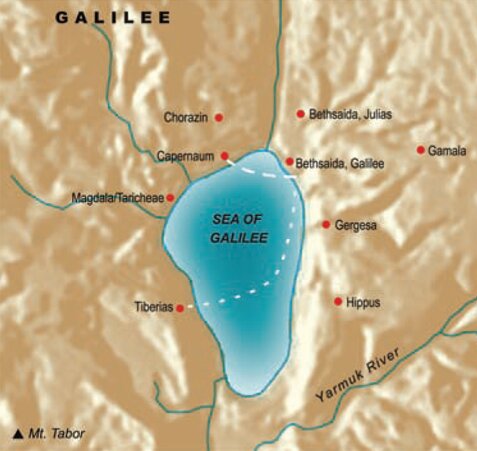
The Miracle (vs. 5-13)
Before noting the miracle, consider what vs. 6 says about Jesus: “He Himself knew what He was intending to do” (NASB95). Why not just send the crowd away? John had just been beheaded. Jesus would want to communicate with His disciples, to learn about their journeys (recall they just returned from the limited commission). He had not eaten anything Himself (Mark 6:31). Jesus’ greatness is not simply that He performed an astounding sign, but the very fact that He did anything!
Even though Jesus “knew what he would do” (vs. 6), He first tested His disciples (vss. 5-9). Why? Phillip’s response was a hopeless one(vs. 7). It is unlikely they possessed 200 denarii (200 days wages). Even if they did, it wouldn’t have been enough for such a large crowd. Andrew focused on what they did have: 5 barley loaves (the inexpensive bread of the poor) and two fish. “But what are these for so many?” (vs. 9). Both Philip and Andrew’s responses revealed a lack of faith. According to Mark 6:30 the apostles had just returned from their limited commission where they had done many wonderful signs (cf. Matt. 10:8). Also, the apostles had witnessed the many wonderful signs of Jesus, even healing the people that very day (see Luke 9.11)!
Not only did Jesus meet the need, He did so abundantly (vs. 10-13)! The abundance of Jesus’ provision may be why each gospel writer recorded this miracle. His provision of physical bread pointed to the greater truth that “from his fullness we have all received, grace upon grace” (John 1.16). The abundance was intended to show that it was in Christ where God’s promise that “my people shall be satisfied with my goodness” (Jeremiah 31.14) would be fulfilled.
The Effect of the Miracle (vs. 14-15)
Remember that this miracle occured well into Jesus’ public ministry. His reputation was well established and His signs were why many followed Him (vs. 2). Feeding the large crowd with so little confirmed to many what they had likely already been thinking:
- Jesus is the Prophet foretold in Deut. 18:15-18.
- Jesus is the coming King, cf. Jeremiah 23:5-6.
Note that the idea of the Prophet and king were tied together. While not a king, Moses had been Israel’s leader in the wilderness. No doubt the Prophet “like him” would do the same.
The people’s desire for “bread” (vss. 26-27, 30-31) was connected with their hope that Jesus was the “Prophet who is to come”. After all, Moses gave their fathers bread in the wilderness (or say they said). They took the promises found in such passages as Jeremiah 23:5-6 to mean they would experience physical safety and security, along with freedom from their oppressors (the Romans). This was the hope cherished by many.
Jesus Walks On Water & The People Follow (vss. 16-24)
In John’s account, the importance of Jesus walking on the Sea of Galilee would seem to be tied to the people’s surprise in not finding Jesus and their search for Him (vss. 22-24). However, this account in the synoptic gospels further demonstrated the weakness of the disciples’ faith (see Mark 6.45-52; Matthew 14.28-33).
Textual Notes:
- Vs. 5: Mark 6.33-35 records that the people ran around the lake and that Jesus taught them.
- Vs. 9: note 2Kings 4.42-44 where Elisha fed 100 with 20 barley loaves.
- Vs. 14: “Toward the end of the third century AD, Rabbi Isaac argued that ‘as the former redeemer caused manna to descend…so will the latter Redeemer cause manna to descend’ (cited in Ecclesiastes Rabbah on Ec. 1:9); perhaps the same sentiment coursed through some circles in the first century” (Carson).
- Vs. 15: note John 18.36.
- Vs. 17: Matthew 14.22-23 records that Jesus went into the mountain to pray. Jesus sent the disciples ahead so he could pray in private.
- Vs. 19: “The Sea of Galilee was at its widest point 7 mi (11.6 km) by 12 mi (20 km). So at this point the disciples were in about the middle of the lake” (NET Notes). Note that this occurred during the “4th watch of the night”, i.e. between 3-6AM (see Matthew 14.25).
 Built By Him
Leave a comment