
As noted in our last lesson, Jacob was not a young man by this time in the narrative. He had lived over seventy years and had by his own means secured both the birthright from his brother and the family blessing from his father. Yet, in reality he had secured nothing. And so this chapter finds Jacob leaving his family, alone and on his way out of the promised land. Yet, Genesis 28 is a pivotal point in the life of Jacob because the Lord revealed himself to His chosen one. Jacob would indeed become great, but not because of his own efforts. He would be great because of the Lord’s promise: “I am with you and will keep you wherever you go, and will bring you back to this land” (Genesis 28.15).
Notes From The Text
Vss. 1-5, Jacob Sent To Paddan-aram
- Vs. 1, a short amount of time may have passed since the events of chapter 27, but there is no way to know for certain. No animosity is detected on Isaac’s part, perhaps he understood that he had been wrong in favoring Esau.
- Vs. 2, while Isaac shared Abraham’s determination that his son should not marry a Canaanite woman (vs. 1; Genesis 24.3), he had no reluctance in sending his son out of the promised land (contrast with Genesis 24.5-6).
- Vss. 3-4
- Isaac invoked El Shaddai, “God Almighty” to bless Jacob. Note Genesis 17.1 where the Lord referred to Himself as El Shaddai when confirming His covenant with Abraham.
- The blessing here is a stark contrast with the blessing given in Genesis 27.27-29. Isaac’s desire was that the Lord would give the same blessing as He gave to Abraham (Genesis 12.1-3) and himself (Genesis 26.3-4). However, Isaac understood that he could not give those things to Jacob, only pray that the Lord would grant the blessings.
- The phrase “that you may become a company of peoples” is interesting. “In the word company, from the root ‘to assemble’, the Old Testament term for the church or congregation makes its first appearance, bringing with it the idea of coherence as well as multiplicity. It is associated with Jacob again in 35:11; 48:4.” (Derek Kidner)
- Vs. 5, the scene here is tragic. Jacob had secured the birthright from his brother (Genesis 25.29-34), but now had to leave his family. Jacob had secured his father’s blessing (Genesis 27.27-29) but left with nothing (see vs. 11). Jacob was supposed to inherit the land (vs. 4), but had to leave the land.
Vss. 6-9, Esau Takes A Third Wife
- Vs. 8, see Genesis 26.34-35. Was this the first time Esau had this realization?
- Vs. 9, Esau seemed to think that his marriages were the problem, and not his character. Thus, he took a third wife, but this time he married a relative (see Genesis 25.12-13).
Vss. 10-22, The Lord Appears To Jacob
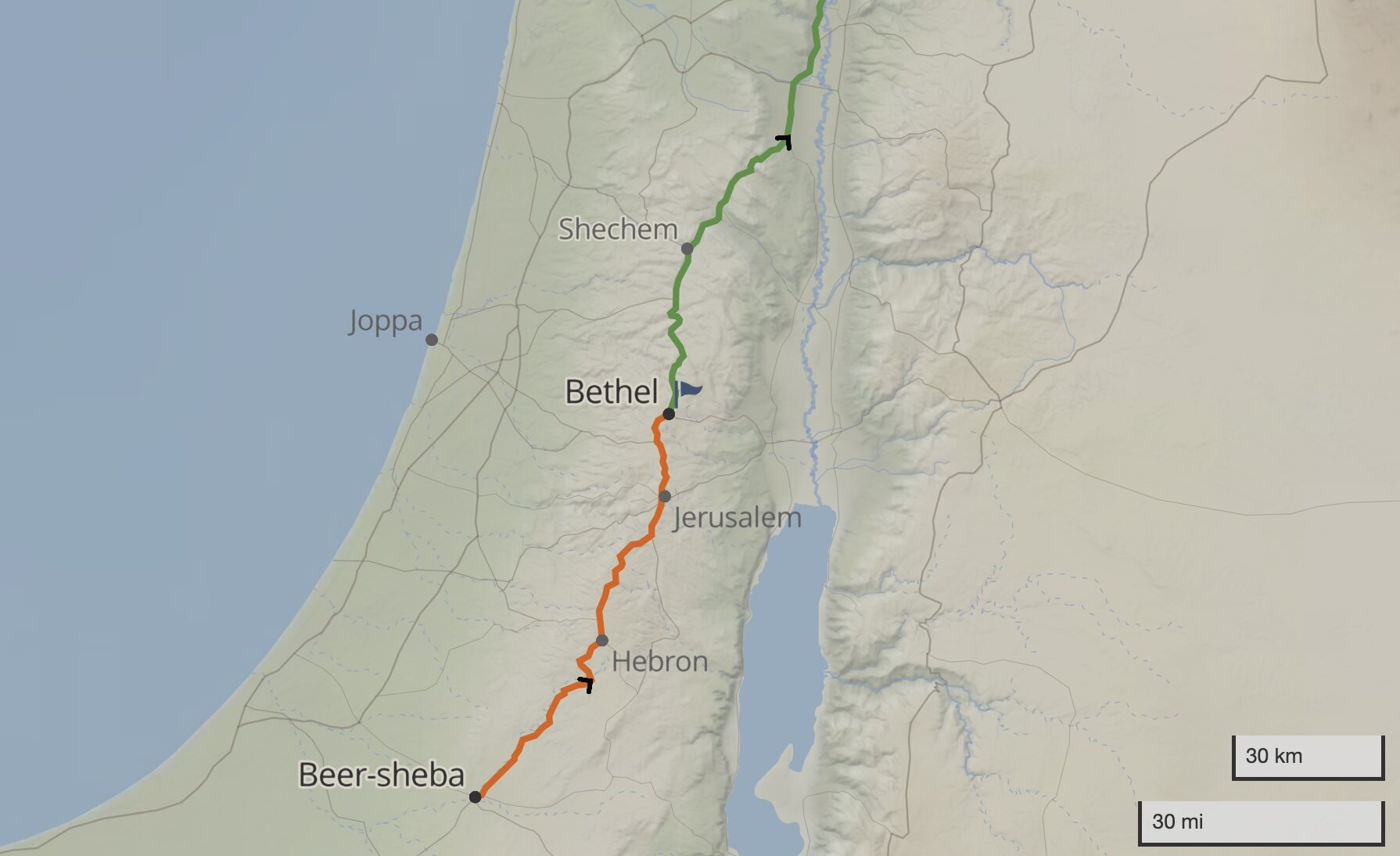
- Vs. 10, Haran would be a journey of approximately 550 miles. Bethel was approximately 60 miles from Beersheba, a journey that would have taken several days.
- Vs. 11
- This was one of Abraham’s first stops in Canaan (Genesis 12.8) and where he worshiped the Lord.
- The difficulty of Jacob’s journey is encapsulated in the statement that he used a stone for his pillow. Note Matthew 8.20.
- Vs. 12
- “From the fact that the messengers of God appear passing between the realms in Jacob’s dream, it is clear that he is viewing a portal to heaven. Such portals are envisioned as stairways (as opposed to ladders) in ancient mythology. They are also architecturally represented in the ziggurats of ancient Mesopotamia, which were built to provide the stairway for the gods to come down and be worshiped in their temples. Jacob is not seeing a ziggurat, but he is seeing the stairway portal between heaven and earth that ziggurats were designed to provide.” (Zondervan Illustrated Bible Background Commentary)
- The activity of the angels showed the Lord’s activity on the earth (see Zechariah 1.10ff; Job 1.6ff). Significantly, Jesus is the ultimate expression of the Lord’s concern for man (John 1.51).
- “From the fact that the messengers of God appear passing between the realms in Jacob’s dream, it is clear that he is viewing a portal to heaven. Such portals are envisioned as stairways (as opposed to ladders) in ancient mythology. They are also architecturally represented in the ziggurats of ancient Mesopotamia, which were built to provide the stairway for the gods to come down and be worshiped in their temples. Jacob is not seeing a ziggurat, but he is seeing the stairway portal between heaven and earth that ziggurats were designed to provide.” (Zondervan Illustrated Bible Background Commentary)
- Vss. 13-15
- Isaac’s hope was realized as the Lord gave to Jacob the blessing of Abraham and Isaac (see vs. 4; Genesis 12.1-3; 26.3-4).
- Contrast the Lord’s blessing with the one given by Isaac in Genesis 27.28-29. Isaac’s blessing sought prosperity and rule, but the Lord’s blessing was ultimately that “in you and your offspring shall all the families of the earth be blessed.”
- Also note the contrast between vss. 13 and 15. The Lord presented Himself as “the God of Abraham your father and the God of Isaac”, but significantly not as Jacob’s God. However, the Lord promised that His presence would be with Jacob and bring him back to the promised land. This was grace, through and through.
- Vs. 16, contrast this verse with Jacob’s words near the end of his life: “the God who has been my shepherd all my life long to this day” (Genesis 48.15). His faith would grow to understand that the Lord had always been present in this life, but at this point Jacob is surprised that the Lord took notice of him.
- Vss. 17-18
- Jacob’s comment and actions here may have reflected the current understanding of how gods operated on the earth. Certain locations were understood to be portals between the heavenly and earthly realms, thus temples and ziggurats were built on those locations (note that Jacob vowed that where he set up the pillar would be God’s house, vs. 22).
- This provides additional meaning to Jesus’ words in John 1.51; if He is where the heavenly and earthly realms come into contact, then He is the true temple (see Matthew 12.6; John 2.20-21).
- Note: Bethel means “house of God”.
- Vss. 20-22
- It is impossible to know the intent behind Jacob’s vow. On the surface, it would seem that Jacob is seeking to bargain with God. If so, Jacob was posing a test to God; you take care of me and I will worship you. However, there are those who see Jacob’s words as that of a normal vow; in other words, once the Lord fulfilled His promise (vs. 15), Jacob was vowing to worship and tithe.
- Note, this was the first recorded tithe given to the Lord, and it was given voluntarily. While the Law commanded that tithes be given to the Lord (Leviticus 27.30; Deuteronomy 14.22), the Lord has always been looking for willing offerings from the heart (see 1Corinthians 16.2; 2Corinthians 8.5; etc.).
Takeaway: A Lesson In Grace
Jacob desired blessings, but so far in the narrative he had tried to secure blessings by his own cunning and schemes. And the results were disastrous! It is not unlike a previous story where man tried to secure his own blessings by building a tower “with its top in the heavens… let us make a name for ourselves” (Genesis 11.4). Those efforts also had disastrous results! The significance of the Lord appearing to Jacob at Bethel is that it is a reversal of the Tower of Babel. Man can’t build a tower to reach the heavens, but he doesn’t need to. The Lord is present and active on the earth (Genesis 28.12) and His blessings come down to His people (Genesis 28.14-15). Jacob needn’t strive for blessings; the Lord would provide! That is grace, the Lord giving to us what we could never attain on our own. And it is why Jesus is the personification of God’s grace, for He came to this earth “full of grace and truth” so that “from his fullness we have all received grace upon grace (John 1.14,16). Truly, it is upon Him that the angels of God ascend and descend (John 1.51).
 Built By Him
Leave a comment