
The birth of Isaac was central to the story of Abraham. This great man of faith (Genesis 15.6) would learn to put even more trust in God as he waited for the promised heir (Genesis 17.15-19) and as he was required to offer Isaac back to God (Genesis 22). However, for all of the buildup to Isaac’s birth, very little text is devoted to the life of Isaac. Abraham, the great man of faith, and Isaac, whose name would be changed to Israel, would be the two great figures in the early history of Israel. However, the life of Isaac is still significant as we will see in these chapters.
Notes From The Text:
25.1-18, Death Of Abraham; His Descendants
- Vs. 1, note that Keturah is referred to as a concubine in 1Chronicles 1.32. It is likely that this passage, even though found after the death of Sarah, refers to another concubine Abraham married earlier in his life (like Hagar, Genesis 16).
- Vs. 2, “Of these children of Keturah, the one we need to emphasize is Midian. He became the chief of the tribe that developed from all these sons. Midian ‘s descendants settled east of the Gulf of Aqaba and ranged north to areas east of the Dead Sea and the Jordan. They were a nomadic people, and at least one branch of them settled in the southern half of the Sinaitic peninsula. When Moses fled from Egypt he lived with a family of Midianites and married Zipporah, the daughter of Reuel (Jethro) who was priest of Midian (see Exod 2:1521; 3:1). The Midianites were enemies of the Israelites throughout most of their history. For example, the Israelites will fight the Midianites near the end of their forty years in the wilderness (Num. 31) and again during the days of Gideon (Judg. 6-8).” (Bob Waldron)
- Vs. 5, remember that Isaac was the only heir (Genesis 21.10-12).
- Vs. 6
- “The children of concubines did not have the status of legitimate heirs. A concubine typically brought no dowry and her children had the status of servants or slaves in the household. They were part of the inheritance rather than recipients of it. Here Abraham sends these children away, thus removing them from any presumed position of privilege; yet at the same time he gives them freedom and gifts. Giving gifts of moveable property (rather than land) would be a typical procedure used to consolidate the chief heir’s inheritance. For Abraham to provide this for these sons is unusual generosity.” (Zondervan Illustrated Bible Background Commentary)
- Note that while these descendants of Abraham were sent away, the Lord prophesied of a time when they would be brought back (Isaiah 60.6ff).
- Vs. 8, the phrase “gathered to his people” signifies an early belief in life after this life. Already, we’ve seen the Lord spare one of His godly ones from death (Genesis 5.24). The Hebrew writer acknowledged the patriarchs were looking for a heavenly reward (Hebrews 11.13-16). Note that Ishmael (Genesis 25.17); Isaac (Genesis 35.29), Jacob (Genesis 49.33), Aaron (Numbers 20.24-26) and Moses (Deuteronomy 32.50) were all gathered to their people.
- Vss. 9-10, see Genesis 24.
- Vs. 11, we will see the particulars of God’s blessing of Isaac in Genesis 26.3-4.
- Vs. 16, note that God fulfilled the promise He had made to Abraham in Genesis 17.20.
25.19-34, Jacob & Esau
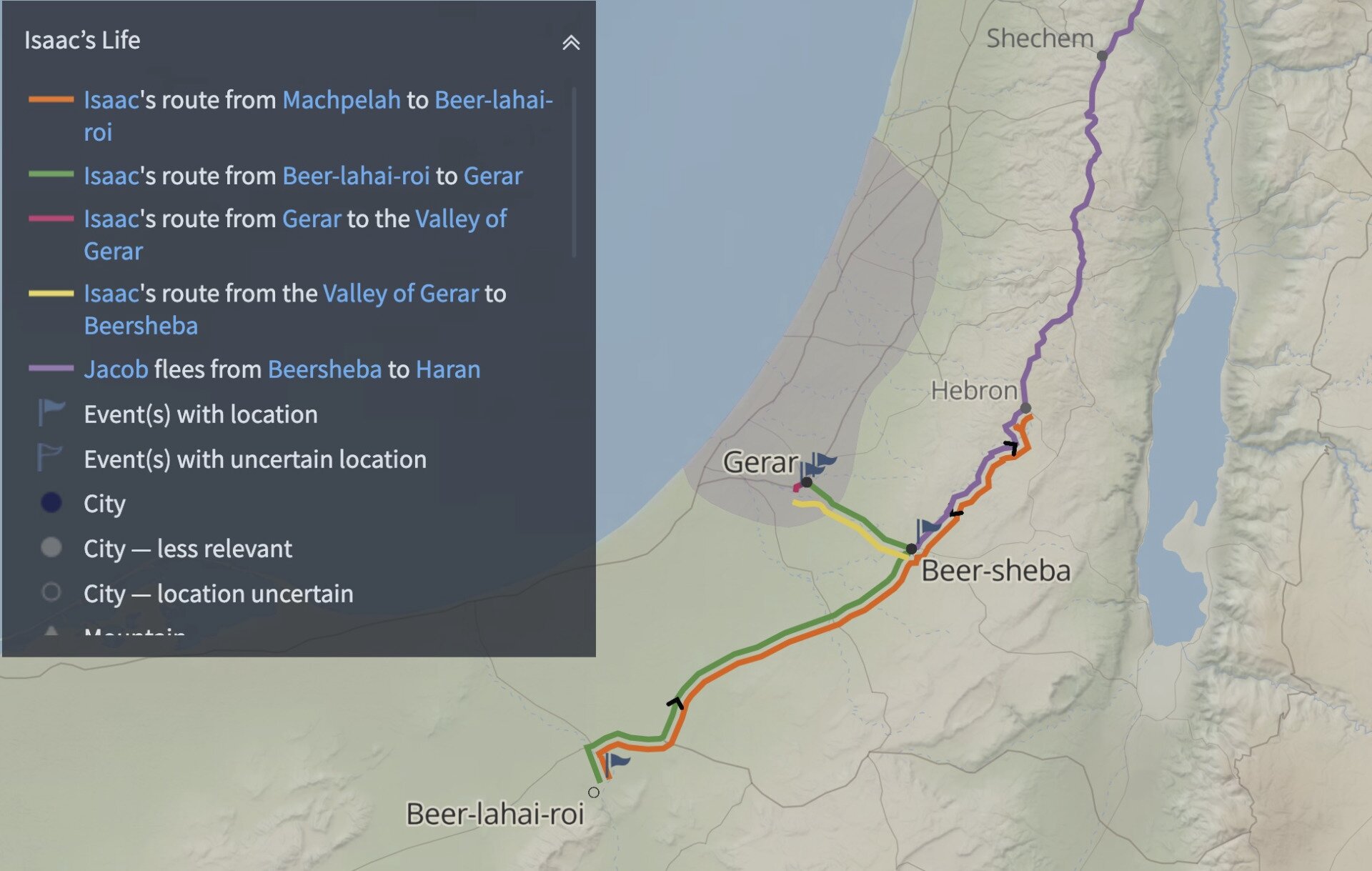
- Vs. 21, note that Isaac was 60 when Jacob and Esau were born (vs. 26). Thus, Isaac’s faith was tested for 20 years. Significantly, Isaac took his concerns directly to God and did not resort to his own efforts (cf. Genesis 16).
- Vs. 23, significantly, Paul would use God’s decision to choose Jacob over Esau to help show that the Lord has the right to choose who would be His people, and how they would become His people (see Romans 9.11-12).
- Vs. 26, “Jacob, an existing name found elsewhere, means ‘May he be at the heels’—i.e. ‘May God be your rearguard’. But it also lends itself to a hostile sense, of dogging another’s steps, or overreaching, as Esau bitterly observed in 27:36. Through his own action Jacob devalued the name into a synonym for treachery; it is taken up in the Hebrew of Jeremiah 9:4 ‘every brother will utterly supplant’” (Derek Kidner).
- Vs. 30, the name Edom sounds like the Hebrew word for “red”.
- Vs. 31, “The birthright consists of the material inheritance. The firstborn usually received a double share from the father because he was expected to become the paterfamilias, having ultimate responsibility for all of the members of the extended family (e.g., mother, unwed sisters) as well as for the continuing care of the deceased. With this greater responsibility came greater resources. When Jacob negotiates to purchase the birthright, it is not clear whether the additional responsibilities come along with that or not. It is likely that this incident involves only the extra share of the inheritance while leadership in the clan is given in Genesis 27.” (Zondervan Illustrated Bible Background Commentary)
- Vss. 32-34, “The Bible states that Esau “despised” his birthright and was, therefore, a profane man (Heb. 12:16). The word profane describes one who does not have a proper regard for things important. From the fact that later Esau was fully prepared to accept the blessing and portion of the firstborn (chap. 27), we infer that he did not take seriously this transaction with Jacob. Even so, Esau was treating what should have been a very, serious matter in a very unbecoming way. In a family such as this, the birthright would have made Esau head of the tribe as well as giving him the major portion of his father’s wealth.” (Bob Waldron)
26.1-5, Promises To Isaac
- Vs. 1, see Genesis 12.10.
- Vss. 2-4, see Genesis 12.1-3; 22.16-18. “The promise was searching: to refuse the immediate plenty of Egypt for mostly unseen (3a) and distant blessings (3b, 4) demanded the kind of faith praised in Hebrews 11:9, 10 and proved him a true son of his father—even though, like Abraham, he was to mar his obedience at once.” (Derek Kidner)
- Vs. 5, note that while Abraham was righteous because of his faith (Genesis 15.6), the promises of God were secured by his obedience (see Genesis 22.18). There is no conflict between faith and obedience, a point emphasized to all of God’s people (Deuteronomy 11.1; James 2.22).
26.6-33, Dealings With Abimelech
Isaac’s encounters with Abimelech serve two purposes. First, they show that while Isaac was a man of faith, he too sometimes struggled with fully trusting the Lord. Second, the encounters emphasize Isaac’s status as a sojourner, living in the promised land but not possessing it. He would be in conflict with those who did possess the land. However, Isaac would be blessed by the Lord (vs. 24), a fact recognized even by Abimelech (vss. 28-29).
26.34-35, Esau’s Wives
“There is more in this notice than meets the eye, for it underlines Isaac’s folly in still favouring Esau for the family headship (cf. 35 with 24:3), and it prepares the ground for Jacob’s despatch in 27:46ff. to his cousins at Paddan-aram.” (Derek Kidner)
 Built By Him
Leave a comment