
In Galatians 3.9 the apostle Paul referred to Abraham as “the man of faith”. So far in our short study of the patriarch’s life we’ve seen his faith on display as he obeyed the Lord’s command to leave his country, family and father’s house and journey to an unspecified land (Genesis 12.1-3; Hebrews 11.8). However, his faith was not perfect as seen in his leaving the promised land for Egypt and his conduct there. Yet, Abraham remains an example of faith because, as we will see in this lesson, his mistakes led him to place greater faith in the Lord and His promises.
Notes On The Text
13.1-13, Abram and Lot Separate
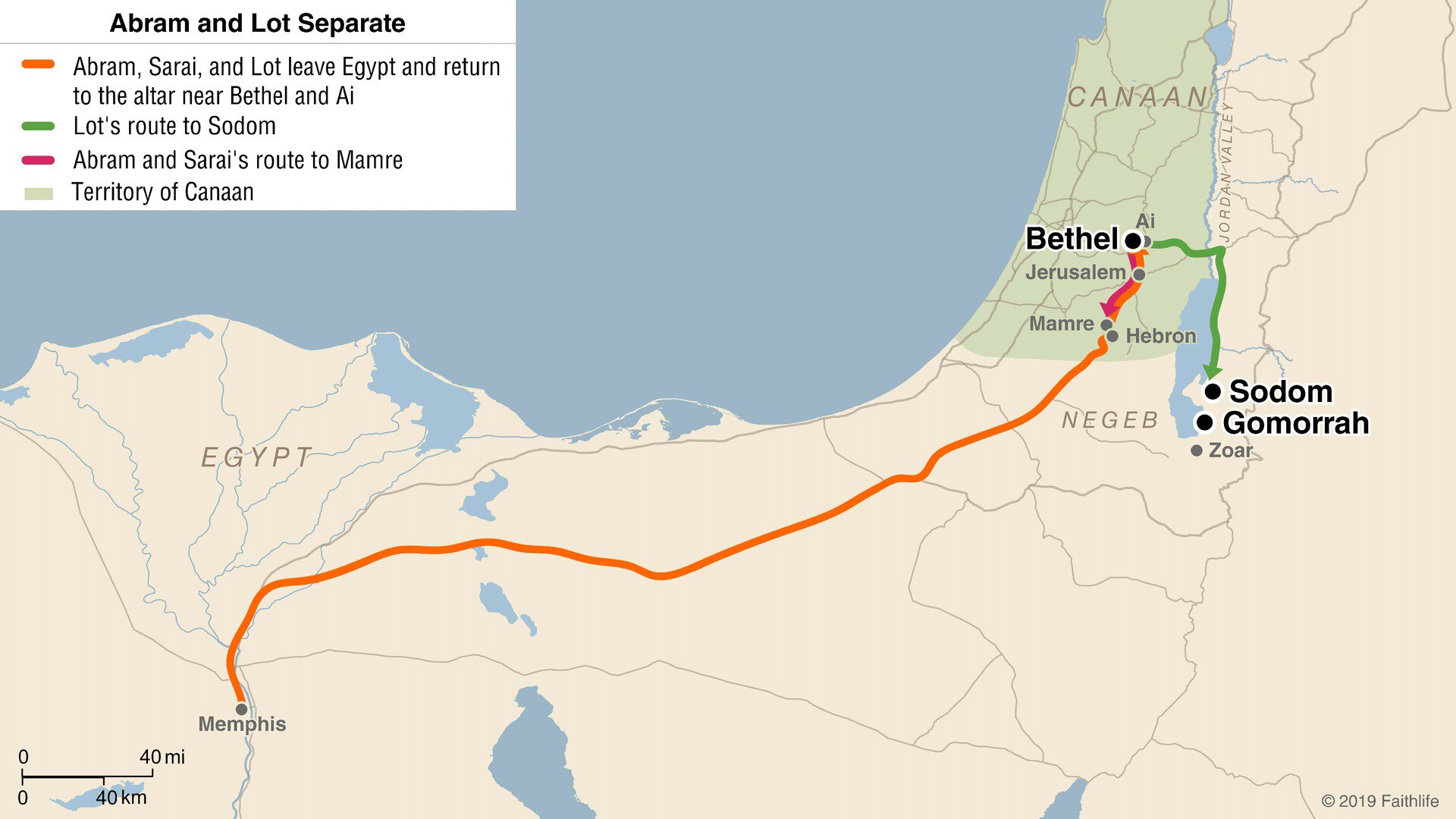
- Vss. 3-4, Bethel was the second location Abram visited when he first entered the land of Canaan (Genesis 12.8). While he had previously built an altar at Shechem, it was at Bethel where Abram first “called upon the name of the Lord”. It’s significant that after his experience in Egypt, Abram returned to this place of worship.
- Vs. 6, interestingly we’ve not been told whether the famine mentioned in Genesis 12.10 had ended. This could possibly explain why the land was unable to support the herds of both Abram and Lot. This was another test to Abram’s faith, but one which he would pass.
- Vs. 7, the mention of the Canaanites and the Perizzites serves two purposes. 1) it helps explain why the land could not sustain the herds of Abram and Lot; others were using the land as well. 2) the conflict between the herdsmen would have been known by these Canaanites, a poor testimony for these servants of the Lord. A real crisis was unfolding.
- Vss. 8-9, Abram’s response is one of faith. He has no desire for conflict and the solution is to place trust in God. That is why he can allow Lot to choose whichever land seems best to him. Abram will be content to go elsewhere trusting that the Lord would provide.
- Vss. 10-11, While Abram was walking by faith, Lot was walking by sight. He could see the quality of the land in the region of Zoar (south portion of the Dead Sea). No consideration was given to the fact that the wickedness of the region was great (vs. 13), Lot wanted what he saw.
- Vss. 12-13, as we will see in vss. 14-18, Abram’s decision was vindicated as the Lord promised all of the land to his descendants; Canaan would belong to Israel. By contrast, Lot was getting ever closer to Sodom and its wickedness, a decision which would have disastrous consequences for Lot and his family (chapters 18-19).
13.14-18, The Lord Confirms His Promises
A note about Abram’s relationship with Lot is warranted here. Recall from Genesis 11.28 that Lot’s father, Haran, died while the family still lived in Ur. Lot made the journey to Haran with Terah, Abram and Sarai and then to Canaan with Abram and Sarai (Genesis 11.31; 12.4). Recall also that Sarai was barren, thus Abram had no children (Genesis 11.30). Thus, Abram probably viewed his nephew Lot as his adoptive heir. But now Abram and Lot have had to go their separate ways. The Lord chose this moment to confirm His promises to His faithful servant.
- Vs. 14, from Bethel Abram could have viewed much of the promised land (View of Bethel (Beitin) looking east with Ai (Et-Tel) in the background. Copyright 2004 The Virtual Bible)
- Vs. 15, the promise that Abram’s offspring would inherit the land “forever” would later be conditioned upon their faithfulness to the Lord’s covenant (see Deuteronomy 28.15ff).
- Vs. 16, amplifies the nation promise made in Genesis 12.2. It’s true fulfillment rests in the fact that Abraham is father of all the faithful (see Romans 4.16).
- Vs. 17, Abram would not possess the land himself, but walking through the land would allow him to appreciate just how gracious the Lord had been with him.
- Vs. 18, Hebron was ~ 20 miles south of Bethlehem and would be the main area associated with the patriarch. Note again that while Abram resided in a tent, he built an altar for the Lord.
14.1-12, Four Kings Against Five
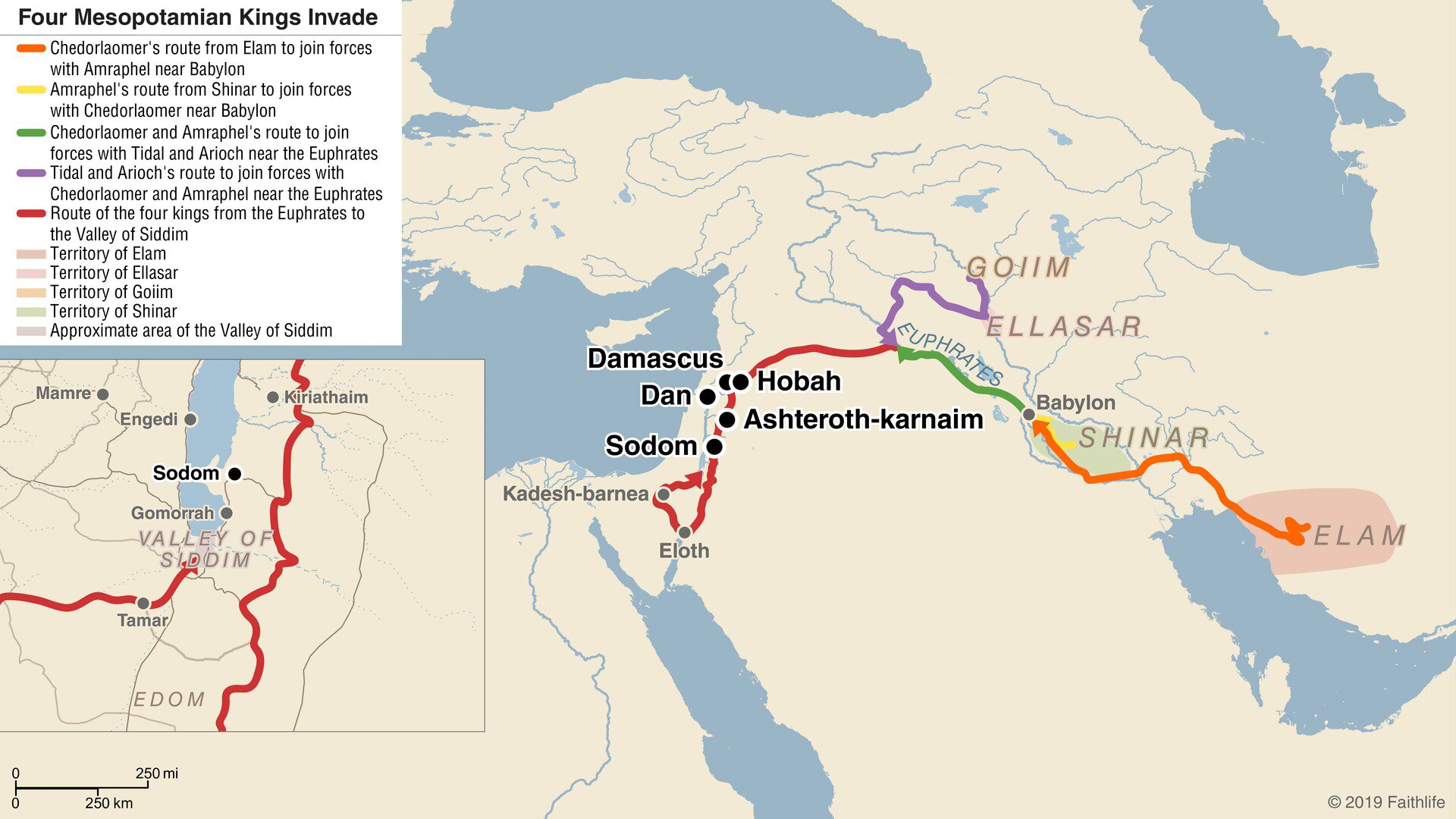
- Vss. 1-9, there is much about this account which cannot be verified in history. However, the account has all the hallmarks of an accurate historical account. While the names of the specific kings (these were local war lords, not kings of empires) have not been found, the names ring true to their various countries. Also, their path from Mesopotamia to the Valley of Siddim was down the well-known Kings Highway, the chief trade route in the entire region. Also, the fact that Canaan was not independent, but subject to other powers matches what we know of the region. Canaan was usually subject to the empires of Egypt or Mesopotamia.
- Vs. 10, “The Dead Sea region is rich in minerals, and the sea was known in Roman times as Asphaltites, from the lumps of bitumen often found floating on its surface, especially in the southern area. These can be quite massive objects.” (Derek Kidner)
14.13-16, Abram Rescues Lot

14.17-24, Abram and Melchizedek
We’ve already noted one encounter between Abram and a ruler, an encounter which could have ended in disaster (Genesis 12.10-20). But Abram’s faith had grown and now he would encounter two kings: one allied with the Lord, the other allied with wickedness.
- Vss. 18-20, Melchizedek was king of Salem (“peace” i.e. Jerusalem) and also priest of the Lord. This mysterious figure would be the subject of prophecy (Psalm 110.4) fulfilled in Jesus. The author of Hebrews makes the following comparisons between Melchizedek and Jesus (Hebrews 7.4-10):
- King of Salem, priest of the Most High God: the Christ can be of the order of Melchizedek since he held both the offices of king and priest. The same cannot be said of Aaron and his line (see vs. 1).
- Blessed Abraham: an important point to establish the superiority of Melchizedek to Abraham (see vss. 6-7).
- Given a tenth of the spoils by Abraham: another important point to establish the superiority of Melchizedek to Abraham (see vs. 6).
- King of righteousness: literal rendering of the name “Melchizedek” (see vs. 2)
- King of Salem, which is king of peace: note that Salem is another name for Jerusalem (see vs. 1; Psalm 76.2).
- Without father, without mother (see vs. 3). There are some who take this to mean that Melchizedek was either a theophany (manifestation of God on earth) or an angel. However, such a conclusion is not warranted or needed. The author is merely making a point from what the text does not say to establish another linkage with the Christ. “Melchizedek’s priesthood was not established upon the external circumstances of birth and descent. It was based on the call of God and not on the hereditary process by which the Levitical priesthood was sustained… Melchizedek’s sudden appearance and equally sudden disappearance from recorded history evoked the notion of eternity, which was only prefigured in Melchizedek but was realized in Christ.” (William Lane, Word Biblical Commentary).
- Made like the Son of God, he remains a priest perpetually (see vs. 3) “The writer says that Melchizedek is “made like” (aphōmoiōmenos) the Son of God, not that the Son of God is like Melchizedek. Thus it is not that Melchizedek sets the pattern and Jesus follows it. Rather, the record about Melchizedek is so arranged that it brings out certain truths that apply far more fully to Jesus than they do to Melchizedek.” (Leon Morris, Expositors Bible Commentary).
- One comparison not made by the Hebrew writer was that Melchizedek gave “bread and wine” to Abram, the very elements Christ used to commemorate what He gives to us (see Matthew 26.26-29).
- Vss. 21-24, contrast this with Abram’s encounter with Pharaoh (Genesis 12.10-20). Then Abram accepted all of the Egyptian kings gifts. How could he not, having acted so deceitfully? But now Abram rejects any material gift from this pagan king. It is enough to have received bread, wine and a blessing from the Lord’s king and priest.
 Built By Him
Leave a comment