
From man’s perspective, leaving Ur would not have made much sense. If we date Abram’s migration to Canaan at approximately 2050 B.C., then Ur would have been at the height of its wealth and power. Ur-Nammu founded a small empire at Ur around that time and the city boasted a population of ~25,000. It’s location near the Persian gulf and the Indus valley would have brought wealth to the inhabitants and its status as the favored city of the moon god, Sin, would have spread its fame throughout the region. Scale model of Ur
Perhaps this was why Terah did not complete the journey to Canaan, choosing to stay in Haran (Genesis 11.31). Haran was not necessarily on the route one would normally take from lower Mesopotamia to Canaan. However, the city was prosperous, located near a crossroads of trade routes and was also devoted to worshiping the moon god Sin. Terah may not have been willing to abandon his old gods to follow the call of the Lord (see Joshua 24.2).
So, why did Abram go? “By faith he went to live in the land of promise, as in a foreign land, living in tents with Isaac and Jacob, heirs with him of the same promise. For he was looking forward to the city that has foundations, whose designer and builder is God.” (Hebrews 11:9–10, ESV) The story of Abram / Abraham is a story of faith, and according to Paul, “it is those of faith who are the sons of Abraham… blessed along with Abraham, the man of faith” (Galatians 3.7,9). In this lesson we will note the promises made to Abraham as well as how he followed the Lord in faith, although not perfectly.
Notes From The Text:
Vss. 1-3, Promises to Abraham
- Vs. 1
- The Lord’s command to Abram was one which required separation. There is one significant difference between the Lord’s command issued when Abram was at Haran and the previous command issued at Ur (see Acts 7.2-3): at Ur Abram had been commanded to “go out from your land and from your kindred” but now the Lord added that Abram must also go out from “your father’s house”. As we’ve already noted, the Lord had good reason to separate Abram from the idolatry of his environment, including in his own family! The Lord continues to call us to separate ourselves from anything and anyone who would hinder our faith (see Luke 14.26; 2Cor. 6.14-18).
- Note that while Abram is given one command to follow, the rest of the passage is what the Lord would do: “I will show” (vs. 1), “I will make” (vs. 2), “I will bless” (vss. 2-3).
- Abraham’s obedience was an act of faith (see Hebrews 11.8). He did not know where the Lord was calling for him to go, all he could do was trust the Lord and yield to His call.
- Vs. 2
- Recall from Genesis 11.30 that Sarai was barren. The promise that Abram would become “a great nation” would have beyond his wildest hope. This promise, which would require a descendant, will test the faith of Abraham and Sarai throughout the coming chapters.
- Note that God would “bless” Abram so that he in turn would “be a blessing”. Vs. 3 specifies how it was that Abram would be a blessing.
- Vs. 3
- The promise that “in you all the families of the earth shall be blessed” is later clarified to “in your offspring shall all the nations of the earth be blessed” (Genesis 22.18). This is a continuation of the seed promise found in Genesis 3.15.
- The Lord’s promise to bless or curse others based on their regard for Abraham is based on the seed promise. As we will note later in this chapter, Abram was not always deserving of blessings from others.
We cannot overstate the importance of these verses. First, they are key to the rest of Scripture as we see the promises to Abraham are fulfilled:
- His descendants would become a great nation (Exodus 1.7).
- His descendants would inherit the land God showed to Abraham (vs. 7; Joshua 21.43).
- Abraham’s offspring would indeed bless all families of the earth (Galatians 3.8,16).
Unfortunately, Israel (the physical descendants of Abraham) did not comprehend the full magnitude of the promises. While they were the physical offspring and inherited the physical land, they did not realize that their favored status was due to the fact that the promised offspring would come from them. The New Testament makes sure we understand that those of faith are the true recipients of God’s promises; we are the true heirs of Abraham (Galatians 3.8,26-29).
Vss. 4-9, Journey to Canaan

- Vs. 6, Shechem would play a significant role in the history of Israel. It was here that Israel would choose between blessing and curse (Deuteronomy 11.29-30), where Joshua would give his farewell charge to the people (Joshua 24) and where the kingdom would divide (1Kings 12). The “oak of Moreh” may have been a site of pagan worship or soothsaying. The note that “Canaanites were in the land” would have been a test of faith for Abram; how could he inherit a land already inhabited?
Bibleplaces.com
- Vs. 7, Shechem was situated between the twin peaks of Ebal and Gerizim. From their heights, Abram could have seen much of the land stretched out in front of him. From there, the Lord promised that Abram’s offspring would be given the land.
- Vss. 7-8, note that at both Shechem and Bethel, Abram constructed altars for the Lord. Abraham would not possess the land (note he “pitched his tent”) but he built altars to the Lord wherever he journeyed!
Vss. 10-20, Faith Tested in Egypt
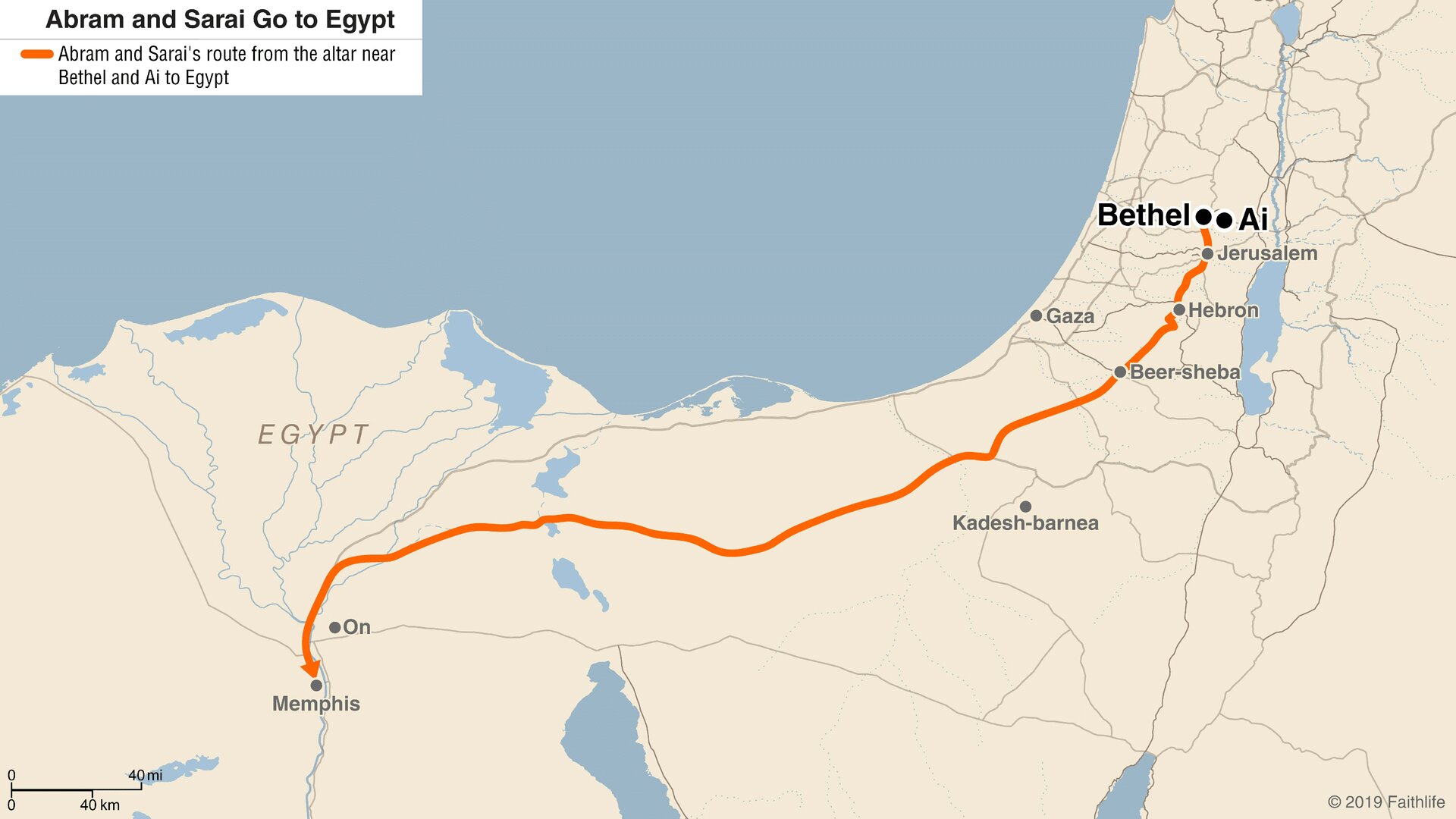
- Vs. 10, Abram’s faith was tested. The land God showed him was inhabited by wicked Canaanites (vs. 6) and was subject to famine (vs. 10)! It is significant that the Lord is not mentioned until vs. 17; Abram acted based on his own wisdom in going to Egypt. It would seem that he did not trust the Lord to provide for him in the land.
- Vs. 11, Sarah was 65, but she did not die until the age of 127. Thus, here appearance would likely have been similar to a woman in her 30s today.
- Vs. 13, note Genesis 20.13. This was their procedure wherever they went. Again, the Lord is not mentioned. Abram is taking matters into his own hands.
- Vs. 16, contrast this with Abram’s refusal of the king of Sodom’s gifts (see Genesis 14.22f). In that case Abram was fully trusting in the Lord, whereas in Egypt Abram was relying on his own wisdom and thus could not reject the gifts given to him in exchange for his own wife.
- Vs. 17, Abram was supposed to be a blessing to others (vs. 3), but on this occasion his failure to trust in God brought a curse on others. The Lord’s actions in cursing Pharaoh were not approval for what Abram had done, but His preserving the promises He had made.
- Vs. 20, “While he was in Egypt Abram lost time of fellowship with God in Canaan. He also lost his testimony to Pharaoh.” (James E. Smith)
 Built By Him
Leave a comment