
Once before man had completely removed God from his calculations and had suffered the consequences. When “every intention of the thoughts of his heart was only evil continually” the Lord determined to “blot out man whom I have created from the face of the land” (Genesis 6.5,7). And while the Lord had preserved the human race by rescuing righteous Noah and his family, we’ve already noted in our study how quickly man began to turn away from God’s will (Genesis 9.20-22). Chapter 11 again finds the world in open rebellion to the Lord. However, the chapter ends with a look at the family through whom the Redeemer of the world would come.
Notes From The Text
Vss. 1-9, The Tower of Babel
- Vs. 2, recall from Genesis 10.10 that one of Ham’s descendants, Nimrod, began his kingdom with the cities of Babel, Erech, Accad and Calneh in the land of Shinar.
- Vss. 3-4, man’s actions in this passage reveal three sins
- Disobedience. They people defied the Lord’s command to fill the earth (Genesis 9.1,7) by trying to stay in Shinar and not being scattered.
- Discontentment. Rather than being satisfied with what God had provided, they desired a city for themselves. And with a tower reaching into heaven, they would be more like God.
- Pride. They make no mention of God, rather they wanted to make a name for themselves.
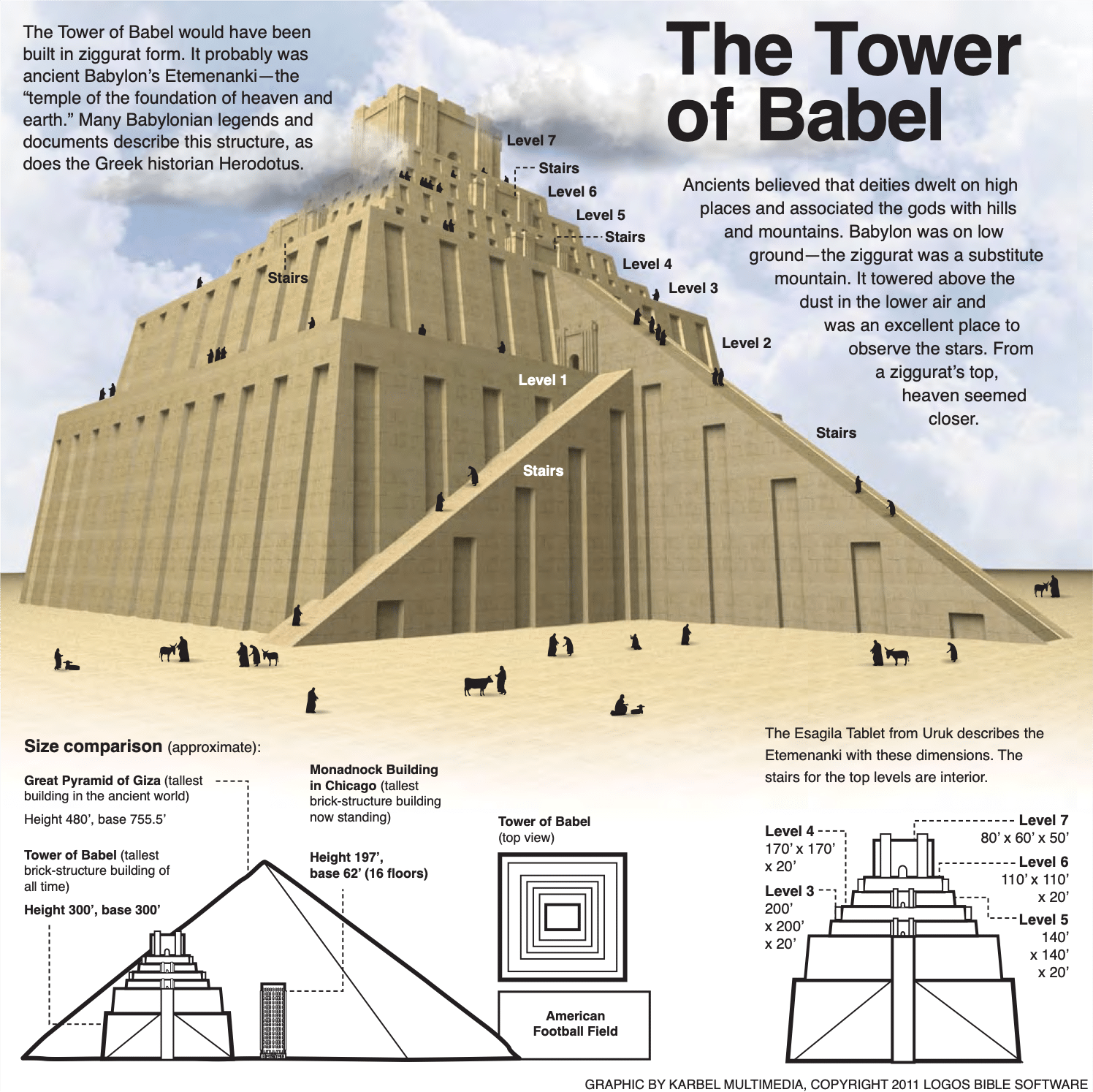
- Vs. 6, “It was not a threat to God personally, whatever man may have done, but it was a threat to His plan for mankind. Perhaps the wickedness of the people would have grown beyond measure had they all remained one, whereas, with the nations separated, some would not be as abased as others. From this moment forward in history, there has never been one global empire.” (Bob Waldron)
- Vss. 7-9, these verses serve two purposes. First, they reveal how the different languages of man came into being, which facilitated the separation of man into various nations (note Genesis 10.5,20,31,32). However, they also show how easily God can thwart the plans of man:
- They aimed to build a tower and city (vs. 4), but God caused them to abandon the city (vs. 8).
- They wished to avoid being scattered (vs. 4), but God scattered the people (vs. 8).
- They aimed to build a tower which would reach into the heavens (vs. 4), but it was God who came down in judgment (vss. 5,7).
- They wanted to make a name for themselves (vs. 4), the resulting name was Babel (which sounds like the Hebrew word for confusion, vs. 9).
- Significantly, in both OT and NT Babylon would represent those opposed to the Lord, but their evil purposes would be defeated (Isaiah 47; Revelation 18).
- Significantly, the Lord would unite the nations by proclaiming the gospel to them… in their own languages (Acts 2.1-12).
Vss. 10-26, The Descendants of Shem
A few notes on the genealogy:
- Like the genealogy from Adam to Noah in Genesis 5, only ten generations are shown. It is quite possible that some generations were omitted.
- Shem’s genealogy was also listed in Genesis 10.21-31. In both accounts, attention is given to the line that would come through Shem’s great-grandson Eber.
- A major difference in the genealogies was that in Genesis 10 the genealogy followed the line of Eber’s son Joktan, while Genesis 11 follows the line of Eber’s other son, Peleg.
Vss. 27-32, The Descendants of Terah
The text now focuses in on the family through whom God’s promise in Genesis 3.15. Abram/Abraham comes to the forefront starting in Genesis 12, but we need to note a few points from the text about Abram’s family.
- Two locations are mentioned: Ur of the Chaldeans and Haran. While the two cities were located 600 miles apart, worship of the moon god, Sin, was prevalent in both.
- Significantly, Joshua 24.2 states that Terah served other gods.
- Acts 7.2-4 states that the call of Abram originally occurred while they lived in Ur. Genesis 11.31 states that Terah led the family from Ur on the way to Canaan. However, he settled in Haran. Was it due to a lack of faith, or did age and health dictate this choice? We cannot be certain.
- What we do know is that Abram would continue the journey to Canaan, looking for the true city of God by faith (see Hebrews 11.9-10). The chapter began with the arrogance of Babel and ends with the faithfulness of the one looking for the city of God. Babylon’s sins would reach into heaven (Revelation 18.5), but the holy city will come down from heaven (Revelation 21.10,24-27).
- Finally, the note that “Sarai was barren” (vs. 30) is more than an incidental detail. Barrenness would be a recurring problem in the family of Abraham (see Genesis 25.21; 29.31). God had promised that redemption would come from the seed of woman (Genesis 3.15), and clearly salvation could only be credited to the Lord.
 Built By Him
Leave a comment