
The flood is one of the best known stories in all of Scripture, and perhaps one of the hardest to fathom. We have witnessed the devastating affects of various storms (hurricanes, tornadoes, floods, etc.) and perhaps our knowledge of just how destructive those localized storms are makes it even harder to comprehend a flood which would destroy the entire earth! Perhaps this is why a growing number of commentators see the Genesis account as speaking of a localized flood rather than one universal in scope. Their understanding would be that the flood affected only the inhabited area of the earth, likely confined to Mesopotamia. However, Scripture as a whole would seem to bear witness to a universal flood.
- The flood is not portrayed a normal/natural occurrence, but a supernatural judgment from God (Genesis 6.17; 7.14; etc.). In fact, the Hebrew word translated as “flood” (mabhul) is used ONLY in reference to the Genesis flood (see also Psalm 29.10).
- The text uses language indicating a universal flood: “all the high mountains under the whole heaven were covered” (7.19), “everything on the dry land in whose nostrils was the breath of life died” (7.22). Consider that if the flood were local Noah’s taking the animals into the ark would have been unnecessary; life would have been preserved in the areas unscathed by the flood.
- The NT speaks of the flood as an event that destroyed the world: “For they deliberately overlook this fact, that the heavens existed long ago, and the earth was formed out of water and through water by the word of God, and that by means of these the world that then existed was deluged with water and perished.” (2 Peter 3:5–6, ESV)
These facts, coupled with the prevalence of flood stories across the world, would point to a universal flood. To Peter’s point, if the Lord destroyed the world once with water, we shouldn’t doubt that He will destroy the world again with fire (2Peter 3.7).
Notes From The Text:
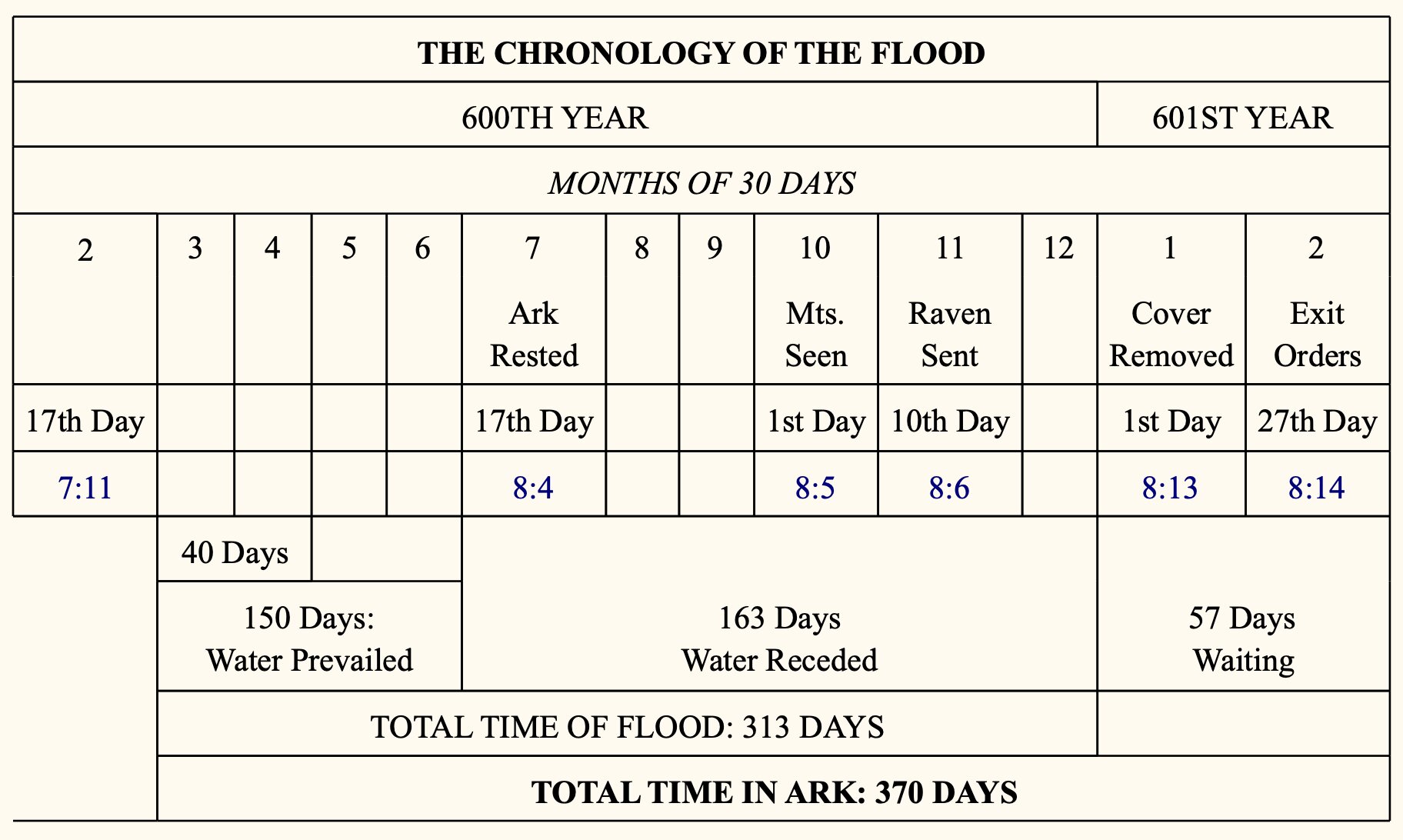
- 7.1, note that Noah is described as “righteous before me in this generation” but salvation would be extended to his entire family. This is not to say that they were not righteous, but the point is established here that the righteousness of one can extend blessings on others. This was the basis of Abraham’s appeal regarding Sodom (see Genesis 18.22ff). More importantly, it is how salvation has been made available to all men: “by the one man’s obedience the many will be made righteous” (Romans 5.19)
- 7.2, previously the Lord had commanded Noah to bring two of every animal into the ark (6.19). To that general command the Lord added the specific requirement that Noah take “seven seven” (the literal Hebrew) of the clean animals into the ark. The ESV translates this as “seven pair” which may very well be the meaning.
- 7.4, the warning that total destruction would occur in seven days may hearken back to the creation account: God who created all things in seven days (including the day of rest) would now after that same amount of time destroy all things.
- 7.8, conservative estimates are that Noah would have only needed to take ~50,000 animals into the ark. Giving the average size of a sheep, the ark could have accommodated a vastly larger number.
- 7.11, “We can infer from the statement about the great deep and the windows of heaven a vast upheaval of the sea-bed, and torrential rain; but the expressions are deliberately evocative of chapter 1: the waters above and below the firmament are, in token, merged again, as if to reverse the very work of creation and bring back the featureless waste of waters.” (Derek Kidner)
- 7.13, note that monogamy was the general rule, while Lamech’s practice of polygamy (Genesis 4.19) was the outlier and practiced by a very wicked man.
- 7.16, Noah serves as an example of faithful obedience (6.22; 7.5; cf. Hebrews 11.7). However, the note that “the Lord shut him in” emphasizes again that this salvation was accomplished by God and not by man. “the expression beautifully shows God’s fatherly touch, at the very brink of judgment.” (Derek Kidner)
7.19-20, remember that the earth was destroyed by the flood (see 2Peter 3.5-6). Thus, the mountain ranges which exist now, may not have existed when the flood began, and may very well be the product of the flood. The 15 cubits may very well have been the draught of the ark (half its height). - 8.1, “God remembered” does not indicate any forgetfulness on God’s part, but is covenant terminology. God had made a covenant with Noah, promising to save him and his family (Genesis 6.18). God was remembering and fulfilling that promise.
- 8.4, Mount Ararat is ~17,000 feet, but the text indicates the ark could have rested on any of the mountains in that range.
- 8.15-17, note that through death (the flood) life would flourish and prosper. In other words, salvation is equated to new life or a new creation (see Romans 6.1-4). “The New Testament sees the flood and the rite of baptism as twin expressions of this reality (1 Pet. 3:18–22): that is, of the provision of a way through death into life.” (Derek Kidner)
- 8.21-22, “God resolved that he would not again “curse the ground” because of man. Never again would there be a such a massive destruction of life as occurred during the Flood. The reason for this divine resolution is clearly stated: “The imagination of man’s heart is evil from his youth” (8:21). God would have to schedule worldwide catastrophes in every generation if he were to respond to human corruption as he did at that time. By demonstrating his wrath against sin in the days of Noah, God had accomplished his purpose.” (James E. Smith)
The great lesson that Israel should have taken from this text, and that we would do well to remember as well, is that God is faithful to His word. He had declared that He would “blot out man whom I have created from the face of the land, man and animals and creeping things and birds of the heavens” (Genesis 6.7) and while that judgment was delayed some 120 years (Genesis 6.2), the Lord kept His word. But the Lord had also promised to save Noah, his family and some of all creation (Genesis 6.18). The Lord “remembered” this covenant (Genesis 8.1) and brought them safely through the devastation (Genesis 8.15-17). The Lord brought Israel into a covenant with both promises and blessings offered, depending on the people’s faithfulness (Deuteronomy 28). The Lord would keep His word; He blessed Israel when they followed Him, but He also brought all the curses upon their disobedience.
God has warned us that judgment is coming and the flood bears witness to the fact that God will keep His word (2Peter 3.5-7). “Since all these things are thus to be dissolved, what sort of people ought you to be in lives of holiness and godliness, waiting for and hastening the coming of the day of God, because of which the heavens will be set on fire and dissolved, and the heavenly bodies will melt as they burn! But according to his promise we are waiting for new heavens and a new earth in which righteousness dwells.” (2 Peter 3:11–13, ESV)
 Built By Him
Leave a comment