
“God gave them up” (Romans 1.24,26,28) are some of the saddest words in all of Scripture. While Paul was speaking of the world’s departure from God in general, his words in Romans 1.21-22 would have application to Adam and Eve: “For although they knew God, they did not honor him as God or give thanks to him, but they became futile in their thinking, and their foolish hearts were darkened. Claiming to be wise, they became fools,” (Romans 1:21–22, ESV). And in man’s foolish, he would continue to depart further and further away from the Lord God. None of this pleased the Lord, but what could be done other than to “give them up”? Sadly, this is exactly what we see happen in Genesis 4 where Cain and his descendants are “given up” to go the way of their choosing.
Cain & Abel (4.1-5)
As severe as the consequences of sin had been, vs. 1 helps us see that not all hope was lost. First, the continued unity between husband and wife is shown by the fact that the sexual relationship is termed as “knowing”. Furthermore, Eve’s hope in God was shown in the naming of her first son, Cain: “I have gotten a man with the help of the Lord.” While some believe Eve thought Cain was at least a partial fulfillment of the Lord’s promise in Genesis 3.15, a likely explanation is she was expressing gratitude to her Lord (Yahweh) that he had seen her through the difficulties of childbirth (see Genesis 3.16).
Much has been made about the differences between what Cain and Abel offered to the Lord (vss. 3-4). However, according to the Law grain offerings were acceptable to the Lord (see Leviticus 2.1; Deuteronomy 26.1-11). The issue was not WHAT was offered, but HOW it was offered. According to Hebrews 11.4, Abel’s offering was made by faith; he sacrificed more than the firstborn of his flock, but offered his trust and heart as well. Meanwhile, Cain’s anger showed that the object of his offering was not the Lord, but himself. He desired favor and praise more than pleasing the Lord.
Cain’s Sin (4.6-8)
The Lord’s grace and mercy come to the forefront again as He seeks to prevent Cain from going further into sin (vs. 6). Sin is here presented as a fierce predator (cf. 1Peter 5.8), but sin is not so powerful that man cannot resist. Note that Calvinism (and other doctrines) teach that since Adam’s sin mankind has become so depraved that he cannot even want to do God’s will. The Lord’s words in vs. 7 are a direct rebuttal to this damnable doctrine.
Sadly, Cain did not seek to master sin, but gave into his own lusts (anger) and murdered his brother. And in doing so, Cain showed his spiritual heritage: “We should not be like Cain, who was of the evil one and murdered his brother. And why did he murder him? Because his own deeds were evil and his brother’s righteous.” (1 John 3:12, ESV, see Genesis 3.15)
Cain’s Unrepentant Heart & Punishment (4.9-16)
Once again, the Lord’s mercy comes to the forefront for in questioning Cain, He is inviting this wayward child to confess and repent. But Cain will not, instead denying any and all responsibility for his brother (vs. 9; contrast with 1John 3.11). But the Lord God who created all of us and is personally concerned with each of us, knew that one of His righteous ones had perished (vs. 10). Abel’s blood called for vengeance, and the Lord repaid (vss. 11-12). The ground which once had produced for Cain (vss. 2-3) would produce no more! Yet, Cain remains unrepentant (vs. 13)! No remorse is expressed for his slain brother, not regret for violating the Lord’s will. His only sorrow was over the severity of his punishment, not his sin. Cain had only worldly sorrow, not the godly sorrow of true repentance (cf. 2Corinthians 7.10).
While Cain did not demonstrate proper repentance, he did acknowledge the magnitude of his crimes and that they would result in others seeking to kill him (vs. 14). By the time we get to chapter 5 Adam was 130 years old. We don’t know when the events of chapter 4 occured, but we can be certain that man and woman had been fruitful and multiplied (see Genesis 1.28). It’s impossible to know what the population of the earth was at that time, but it could have easily been in the thousands (if not much larger). And it is likely that most of the earth’s inhabitants still lived in the general area of Eden. Again, the Lord was gracious and promised to protect Cain with a mark and the warning that “if anyone kills Cain, vengeance shall be taken on him sevenfold” (vs. 15). The principle was established from the beginning: “vengeance is Mine, I will repay” (Romans 12.19).
Sadly, Cain remained unrepentant: “Then Cain went away from the presence of the LORD and settled in the land of Nod, east of Eden.” (Genesis 4:16, ESV) Cain had complained that he would be hidden from the Lord’s face (vs. 14), but it was cain who went away from the Lord. Given that the Lord is omnipresent, the statement is not just about physical proximity, but spiritual direction.
One final note before we leave this section. Recall that Cain’s punishment was the just punishment the blood of Abel demanded (vss. 10-12). One of God’s righteous ones had been slain, vengeance must be repaid. With that backdrop, the words in Hebrews 12.24 where Jesus is described as “the mediator of a new covenant, and to the sprinkled blood that speaks a better word than the blood of Abel.” Jesus blood cries out for grace.
The Line of Cain (4.17-24)
The Lord’s curse of the serpent indicated that there would be continued enmity between two seeds or lines: between the line of the serpent and the line of woman (Genesis 3.15). It would seem that the generations of Cain (4.17-24) and Seth (4.25-5.32) are the first records of those two lines. One line, that of Cain, went further and further away from the Lord, while the line of Seth would “call upon the name of the Lord” (4.26).
Note this insightful summary of Cain’s line: “A biased account would have ascribed nothing good to Cain. The truth is more complex: God was to make much use of Cainite techniques for his people, from the semi-nomadic discipline itself (20; cf. Heb. 11:9) to the civilized arts and crafts (e.g. Exod. 35:35). The phrase he was the father of all such acknowledges the debt and prepares us to accept for ourselves a similar indebtedness to secular enterprise; for the Bible nowhere teaches that the godly should have all the gifts. At the same time we are saved from over-valuing these skills: the family of Lamech could handle its environment but not itself. The attempt to improve on God’s marriage ordinance (19; cf. 2:24) set a disastrous precedent, on which the rest of Genesis is comment enough; and the immediate conversion of metal-working to weapon-making is equally ominous. Cain’s family is a microcosm: its pattern of technical prowess and moral failure is that of humanity… Lamech’s taunt-song reveals the swift progress of sin. Where Cain had succumbed to it (7) Lamech exults in it; where Cain had sought protection (14, 15) Lamech looks round for provocation: the savage disproportion of killing a mere lad (Hebrew yeled, ‘child’) for a mere wound is the whole point of his boast (cf. 24). On this note of bravado the family disappears from the story. By contrast, Jesus may well have had this ‘seventy-seven’ saying in mind when he spoke of forgiveness ‘unto seventy times seven’. (Derek Kidner)
The Line of Seth (4.25-5.32)
The promised seed of woman which would ultimately defeat Satan finds its beginning with the birth of Seth (see Luke 3.38). Their spiritual quality is indicated by a couple of statements:
- With the birth of Seth and then his son Enosh, men began to “call upon the name of the Lord”. Clearly worship of the Lord had already taken place (vss. 3-4), but calling on Yahweh may indicate a personal longing on the part of Seth and Enosh.
- In 5.1-3 we read again that Adam was created in the image of God, but then we see that Seth was in Adam’s likeness. Such was not said about Cain, the point would seem to be that with Seth the proper spiritual qualities were also passed down (cf. Genesis 18.19).
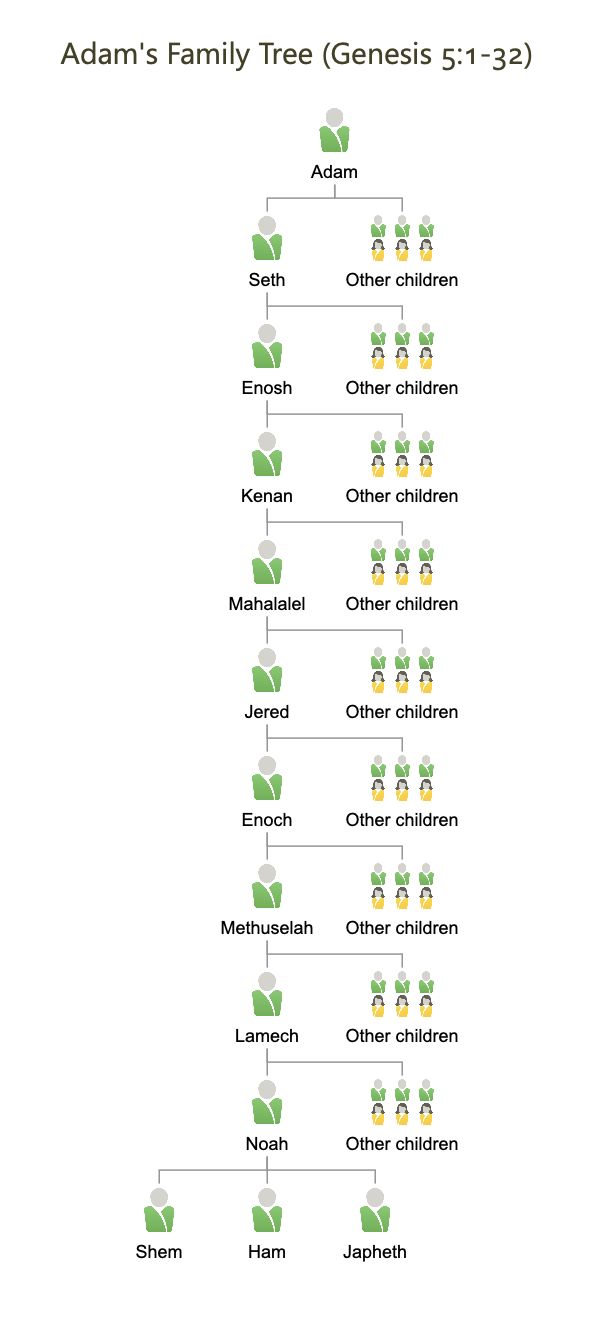
Genesis 5 lists ten names in the generations from Adam to Noah. Significantly, another ten names are listed in the generations from Noah to Abraham (see Genesis 11). The question is raised on whether these genealogies furnish us with exact dating for the age of the earth. First, there is no Scriptural reason to doubt the ages for the men given in these passages. Remember, we are dealing with a different earth before the flood from what the earth would be after the flood (see 2Peter 3.5-6. However, Scripture does not demand that these are the ONLY generations, rather simply the only ones listed in the inspired account. Note that the genealogy of Jesus in Matthew 1 omits several kings found in the Old Testament account. This does not mean that generations were definitely omitted, only that it is a possibility and thus we cannot be dogmatic about exactly when God created the earth.
Special attention should be given to a few figures in Seth’s line. First, it was recorded of Enoch that he “walked with God, and he was not, for God took him” (vs. 24). In contrast with Cain who “went away from the presence of the Lord”, Enoch cultivated such a close relationship with the Lord that he was spared from death! Lamech’s spiritual qualities also come to the foreground because he looked in hope on what the Lord could do through his son, Noah: “Out of the ground that the LORD has cursed, this one shall bring us relief from our work and from the painful toil of our hands.”” (Genesis 5:29, ESV)
 Built By Him
Leave a comment