
Let’s return to the beginning of Acts for just a moment. Luke was writing to Theophilus (literally “lover of God”) and reminded him of “the first book… (that) dealt with all that Jesus began to do and teach, until the day when he was taken up…” (Acts 1.1-2). That “first book” referred to what we now call the book of Luke, a book written for a specific purpose: “it seemed good to me also, having followed all things closely for some time past, to write an orderly account for you, most excellent Theophilus, that you may have certainty concerning the things you have been taught.” (Luke 1:3–4, ESV) Luke’s thorough and detailed recording of events continued as he penned the events found in Acts. Ever since Paul arrived in Jerusalem in Acts 21 we’ve focused on how the apostle defended the faith before his countrymen and before Gentile rulers. In this last lesson let’s note how Luke’s account helps us defend the Kingdom.
27.1-44, The Testimony of Luke’s Accuracy
Chapter 27 is a VERY detailed account of Paul’s trip from Caesarea to Rome. While the account furnishes further proof of Paul’s dedication to the cause of Christ, the account has also proved to be a valuable apologetic. “Luke’s account of the voyage and shipwreck of Paul, who he accompanied from Caesarea to Rome, has been minutely investigated by an experienced Scottish seaman (commodore James Smith), and establishes the remarkable fact that Luke, though not a professional seaman, was a close and accurate observer of the winds and storms, and the management and movements of ship. He furnishes more information of ancient navigation than any single document of antiquity.” (Wayne Jackson). We won’t consider all of the details Luke provided, but these should suffice to show that Luke was a reliable witness to what he saw.
- From Caesarea to Fair Havens (vss. 1-12)
- Vs. 2, Adramytium was a harbor on the coast of Mysia, known for its shipbuilding. This was a coasting vessel which would stay near to shore, stopping at various ports on its voyage.
- Vs. 4, “At some other time of year, when the prevailing winds blew from a different direction, they might have sailed directly from Sidon to Mysia, leaving Cyprus on the right. During this time of year (it was getting late in the sailing season) the prevailing winds, called Etesian winds, blow from the west and northwest. As they sail northward, they would sail past the east side of Cyprus, and while near Cyprus they would be sheltered from the prevailing winds making sailing somewhat easier.” (Garreth Reese)
- Vs. 6, About 300 years earlier, Egypt had become the bread basket of Rome. The grain grown in Egypt had to be shipped to Rome, so a whole fleet of ships was devoted to this trade. It is clear from verse 38 that this Alexandrian ship was one of the grain ships.
- Vs. 7, The shoreline of Asia Minor from Myra westward tends in a more northwesterly direction, and so the sailing was slow because they would have less shelter from the northwest wind.
- Vs. 9, the Day of Atonement took place in September, a time of year designated as the “dangerous season” by sailors on the Mediterranean. Navigation practically ceased from November to March.
- Vs. 12, Phoenix was about 40 miles to the west of Fair Havens.
- From Fair Havens to Malta (vss. 13-44)
- Vs. 13, If the south wind lasted just three of four hours, they could sail the distance and put the ship in the harbor for the winter.
- Vs. 14, we get our word “typhoon” from the Greek word translated as “tempestuous wind”.
- Vs. 17, the Syrtis were vast beds of sand driven up by the sea, and constantly shifting position so that it could not be known with certainty where the sandbars were under the surface of the shallow water.
- Vs. 23, the Lord had stood by Paul on two previous occasions (see Acts 18.9; 23.11).
- Vs. 27, here the “Adriatic Sea” refers to the central part of the Mediterranean.
- Vs. 28, a fathom was about 6 feet.
- Vs. 39, “Malta was an island well-known to experienced seamen, the bay (now known as St. Paul’s bay on the northeastern side) was not the main harbor on this island. It is not unusual, therefore, that this particular spot (of the eighty-five mile shoreline) was not recognized by the sailors.” (Wayne Jackson)
- Vs. 42, Roman soldiers would pay the penalty due the prisoner if the prisoner escaped (see Acts 12.18-19; 16.27).
28.1-10, The Testimony of The Lord’s Signs
Paul and his travel companions would spend the rest of the winter (when sailing was impossible) on the island of Malta. While we do not have any record of Paul preaching while on Malta, some notable miracles were performed. Recall that the purpose of miracles was to show God’s approval (see Mark 16.20; Hebrews 2.3-4). While we may not have been there to witness the miracles, the response of those who did witness these signs provides further confirmation that the apostles were God’s chosen messengers.
- Vs. 4, in their mythology, “Justice” was the daughter of Jupiter, the goddess who insured criminals were punished for their crimes.
- Vs. 5, fulfillment of Mark 16.18.
- Vs. 7, “chief man” was an official designation and has been found on at least two inscriptions at Malta.
28.11-16, The Testimony of Caring Brethren
“By this all people will know that you are my disciples, if you have love for one another.” (John 13:35, ESV) The care which God’s people show for each other has always served as a testimony of the transformation that occurs in Christ. The final leg of Paul’s journey to Rome provided the powerful testimony of brotherly love.
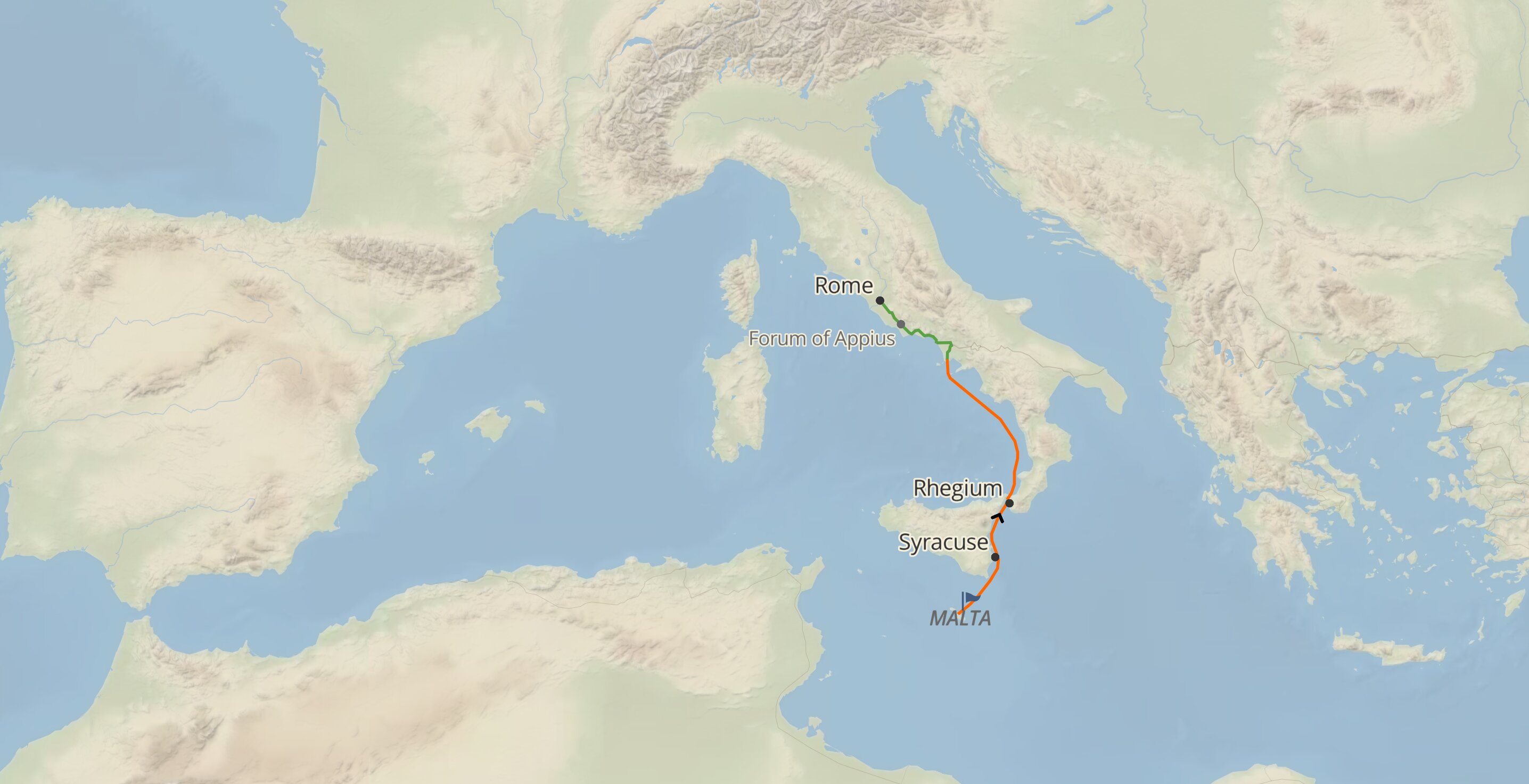
- Vss. 13-14, Puteoli was the harbor where the grain ships were unloaded. It was deep enough to accommodate the deep draft of these large and heavy vessels. We know nothing about the brethren except what we read about them here; they’d never met Paul, but they were willing and eager to host him and his companions.
- Vs. 15, the Forum of Appius was 45 miles from Rome, while Three Taverns was 33 miles from Rome. These brethren provided the encouragement Paul was needing!
28.17-31, The Testimony of the Gospel Message
Luke’s account ends with Paul in Rome for two years, doing exactly what he’d done ever since the road to Damascus; bearing witness for the Lord. Both Paul’s message and his love for souls testifies to the truth of the gospel.
- Vs. 20, Paul had earlier testified that promise Israel hoped to attain was related to the resurrection from the dead (see Acts 23.6; 26.6-8). The hope of Israel is the resurrection of Jesus.
- Vs. 23, Paul was doing for them exactly what Jesus had done for the apostles (see Luke 24.44-47).
- Vss. 24-28, this passage encapsulates Paul’s entire ministry. He desired the salvation of his kinsmen, but most would reject the gospel. However, the Lord sent him to preach to the Gentiles, where he found a much more receptive audience.
- Vs. 31, the book began with Jesus “speaking about the kingdom of God” (Acts 1.3) and it is fitting that it should end with Paul “proclaiming the kingdom.” The Kingdom of the Lord is glorious and it is real.
 Built By Him
Leave a comment