
One of the great “I am” statements of Jesus is His proclamation that “I am the good shepherd” (John 10.11). As our shepherd He knows us (vs. 14), gives us direction (vs. 27), gives us security (vs. 28), and He gave His life for us (vs. 11). He remains our good shepherd! However, before His exaltation into heaven, Jesus asked Peter to “feed” and “tend” His sheep (John 21.15,16,17). Jesus wasn’t singling Peter out to the exclusion of others, for the New Testament makes it abundantly clear that many other leaders/shepherds would exist in the Lord’s church (see 1Peter 5.1-4). What Jesus did make clear was that His people would continue to need good leaders after His departure; shepherds would be needed who would feed and tend His sheep. In this chapter we see some of qualities needed for these Kingdom leaders.
Notes From The Text:
Vss. 1-6, Travels Through Greece

- Vs. 1, Paul wrote 1Corinthians at some point before leaving Ephesus. There he made his intentions known that he would remain in Ephesus until after Pentecost (1Cor. 16.5-9). However, the riot may have prompted Paul to leave earlier than planned (see 2Cor. 1.8). Upon leaving Ephesus, Paul first travelled to Troas where he hoped to find Titus with news from Corinth. When he did not find Titus, Paul set sail for Macedonia (see 2Cor. 2.12-13).
- Vs. 2, While in Macedonia, probably at Philippi, Titus came to Paul and informed the apostle of how the Corinthians favorably received the first epistle (2Cor. 7.5-7). Paul then penned 2 Corinthians and sent it by Titus and two others. Paul then arrived in Greece (i.e. the region of Achaia and the city of Corinth).
- Vs. 3, during this 3 month stay, Paul wrote a letter to the saints in Rome (see Romans 16.23).
- Vs. 4, recall that Paul was raising funds for the needy saints in Judea (1Cor. 16.1-4; 2Cor 8-9; Romans 15.25-27). The men listed in this passage were likely sent by each church who had helped in providing this relief.
- Vs. 6
- Luke’s historical accuracy is show in this passage where the journey against the wind took five days, whereas the journey with the wind only took two days (see Acts 16.11).
- In vs. 16 we will note that Paul would not take the time to visit Ephesus because he was in such a hurry to reach Jerusalem. However, Paul was willing to tarry in Troas for seven days. The only explanation that fits the context is that Paul viewed worshiping with the saints on the first day of the week to be of such importance that he delayed his trip.
Vss. 7-12, At Troas
- Vs. 7, “to break bread” is representative of celebrating the Lord’s Supper (see Acts 2.42; cf. 1Cor. 10.16). That Christians met on the first day of the week to partake of the Lord’s Supper is also established in 1Cor. 16.2; 11.20.
- Vs. 10, Paul’s words here do not mean that Eutychus did not die, because Luke clearly states that he did in fact die (vs. 9). Rather, Paul spoke with the same assurance as Jesus did that through God’s power, life would be restored (see Matthew 9.23-25).
Vss. 13-38, Meeting The Ephesian Elders At Miletus
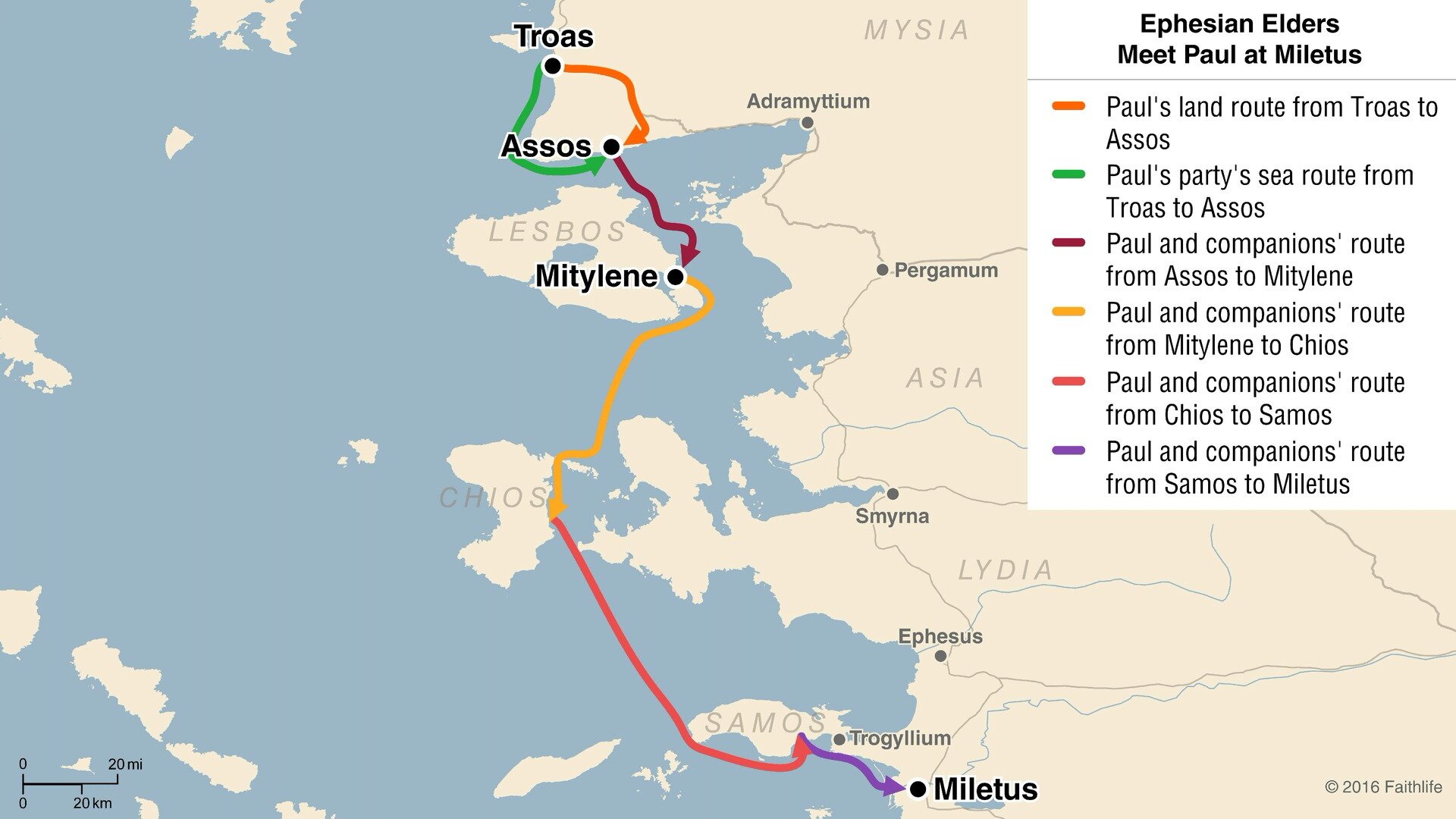
- Vs. 17, “elders” (presbuteros) were first mentioned in Acts 11.30 and we noted how they were appointed in Acts 14.23. Their qualifications are given in 1Timothy 3 and Titus 1. Note that they are also called bishops/overseer (episkopos) who do the work of shepherding in vs. 28.
- Vs. 19, Paul did not approach the gospel as a cold academic, but as a sinner transformed who understood how much all people need Jesus. Thus, his whole being, including his emotions, were tied to his labors (see vs. 31; 2Cor. 2.4; Phil. 3.18).
- Vs. 21, it is interesting to note how Paul summarized the gospel in his preaching (cf. Acts 24.24-25). On this occasion, the apostle summarized the message as 1) repentance toward God and 2) faith in our Lord Jesus Christ. Both are essential, neither is profitable without the other.
- Vss. 22-23, note that while Paul was “constrained by the Spirit” (“bound” or “compelled” in other translations), the same Spirit warned Paul of what awaited him (Acts 21.4,11).
- Vs. 24
- For Paul’s attitude toward his life see Philippians 1.21-24. “finish my course” makes use of one of Paul’s favorite metaphors: an athlete competing for the prize (see 1Cor. 9.24-27; Phil. 3.14; 2Timothy 4.7).
- Compare this with vs. 21; “the gospel of the grace of God” does not exclude the necessity of repentance and faith.
- Vs. 25, it would seem that Paul would again visit Ephesus (see 1Timothy 1.3; 3.14; 4.13). Paul probably took the Spirit’s warnings (vs. 23) to mean that he would die in Jerusalem, thus his belief that they would never see his face again.
- Vs. 26, note Ezekiel 33.
- Vs. 27, “for I didn’t shrink from declaring all that God wants you to know” (NLT). Paul’s aim wasn’t to simply communicate the basics of the gospel, but ALL that the Lord commanded (see Matthew 28.20).
- Vs. 28
- Elders (vs. 17) have the task of overseeing the flock and provide all the care a shepherd would provide for the sheep (compare with Matthew 2.6).
- Note that when Paul spoke of “the church of God, which He obtained with His own blood”, he wasn’t speaking of the universal church, but the church at Ephesus which these overseers were called to care for. Can anyone possibly argue that the local church is unimportant?
- Vss. 29-20, Paul’s words were proven to be true when perhaps 30 years later the church at Ephesus would be described as having left their first love (Revelation 2.1-7).
- Vs. 32, “To ‘commend’ is literally ‘to place beside, to entrust.’ The apostle had done what he could; he ‘deposits’ them with God.” (Wayne Jackson)
- Vss. 33-34, depending on the circumstance, Paul would often work in order to provide for himself (Acts 18.3; 1Cor. 4.12). However, on other occasions he would be supported by generous brethren (Philippians 4.14-18). He would argue that those who proclaim the gospel have the right to support for this work (see 1Cor. 9.9ff).
- Vs. 35, these words are not recorded in the gospel accounts, but are similar to Matthew 10.8.
Leadership In The Kingdom
When Paul met with the Ephesian elders at Miletus, he spoke to these shepherds as one who himself loved the people of God. There are several points we can take away from this passage about what true leadership in the Kingdom should look like; lessons not just for elders in the local church, but for all of us.
- Leading is serving (vs. 19). Paul termed everything he did while in Ephesus as “serving the Lord”. This was true because He had commissioned Paul to this work (Acts 9.15), but also because all service done to the Lord’s people is done for Him (see Matthew 25.40).
- Leadership takes an emotional toil (vss. 19, 31). When recounting his many hardships, Paul stated that “apart from other things, there is the daily pressure on me of my anxiety for all the churches” (2Cor. 11.28).
- Leadership requires teaching ALL of the Lord’s will (vss. 20,27). The “whole counsel of God” must be proclaimed because it is all “profitable” (cf. 2Timothy 3.16-17).
- Leadership requires sacrifice (vs. 28). Paul was willing to sacrifice his life to complete the work the Lord had given him (vs. 24) and implied in his exhortation was that the Ephesian elders would also sacrifice much as they tended the Lord’s sheep. But all of our sacrifices pale in comparison to the one our Lord made for us, for we were “obtained with his own blood”.
- God is with His leaders (vs. 32). No greater aid could be given than our God and “the word of His grace”. It is He who builds us up, who sanctifies us and who gives us an inheritance.
 Built By Him
Leave a comment