
Most of us wouldn’t think of Las Vegas as being a city primed to receive the gospel. After all, who in “sin city” would be interested in repentance and holiness? Likewise, who in Manhattan would forsake the pursuit of material gain and “hunger and thirst for righteousness” instead? Or what citizen of Tehran would forsake Islam in order to submit to Jesus Christ? Just as we can think of any number of reasons why various groups of people would likely reject the gospel, Paul could have thought the same about the city of Corinth. Commercially vibrant, pagan to the core and given over to immorality. Yet, the Lord declared to His apostle, “I have many in this city who are my people” (Acts 18.10).
Vss. 1-17, Corinth

- Vs. 1
- Corinth was located on the narrow isthmus that bridges mainland Greece to the Peloponnese and separated the Saronic and Corinthian Gulfs. It’s location made it the commercial capital of Greece as it controlled the overland between the mainland and the Peloponnese as well as the sea trade between Italy and Greece. Ships would be brought overland across the narrow isthmus rather than sail the 200-300 miles around lower Achaia.
- The city was the Roman capital of Achaia and boasted a population of roughly 500,000.
- The immorality of the city was known throughout the Mediterranean world. A temple to Aphrodite commanded the heights outside of the city and there 1000 temple prostitutes “served” the deity. So debauched was the city that “Corinthian girl” became a common way of referring to a prostitute.
- Vs. 2, Claudius was Caesar from A.D. 41-54 and at this time there were an estimated 20,000 Jews living in Rome. The historian Suetonius states that “the Jews were in a state of constant tumult at the instigation of one Chrestus”. It is possible that “Chrestus” was a reference to Jesus Christ. Seutonius states that the edict was made in AD 49.
- Vs. 5, see Acts 17.15.
- Vs. 6, Paul’s responsibility was to proclaim the gospel. If people rejected the message, they were responsible for their own blood (see Ezekiel 3.18ff; 33.4-8).
- Vs. 7, Paul choosing to teach in the house of Titius Justus might indicate a willingness that any honest Jews still have the opportunity to hear the truth, since his house was next to the synagogue.
- Vs. 8, Crispus was personally baptized by Paul (see 1Corinthians 1.14).
- Vs. 9, the NASB reading is preferable: “Do not be afraid any longer”. We would reason that Paul’s fear was justified given his experiences at Philippi, Thessalonica and Berea.
- Vs. 11, during this stay Paul wrote two epistles to the brethren in Thessalonica.
- Vs. 12, Gallio became proconsul in AD 51. The very tribunal mentioned in this verse was discovered in 1935.
-
- Vs. 13, Judaism was a recognized, and therefore legal, religion by the Romans. The Jews argument in this passage was that Christianity was not Judaism, thus not a legal practice.
- Vss. 14-15, Gallio clearly did not buy the Jews’ argument. At this point Christianity would be viewed by the Romans as a sect of Judaism, thus have legal protection.
- Vs. 17, we are not told who beat Sosthenes. It may have been the Jews who were upset out the outcome, but the more likely explanation is that the Greeks beat him out of animosity for the Jews. Sosthenes may have become a Christian (see 1Corinthians 1.1).
Vss. 18-23, Return To Antioch
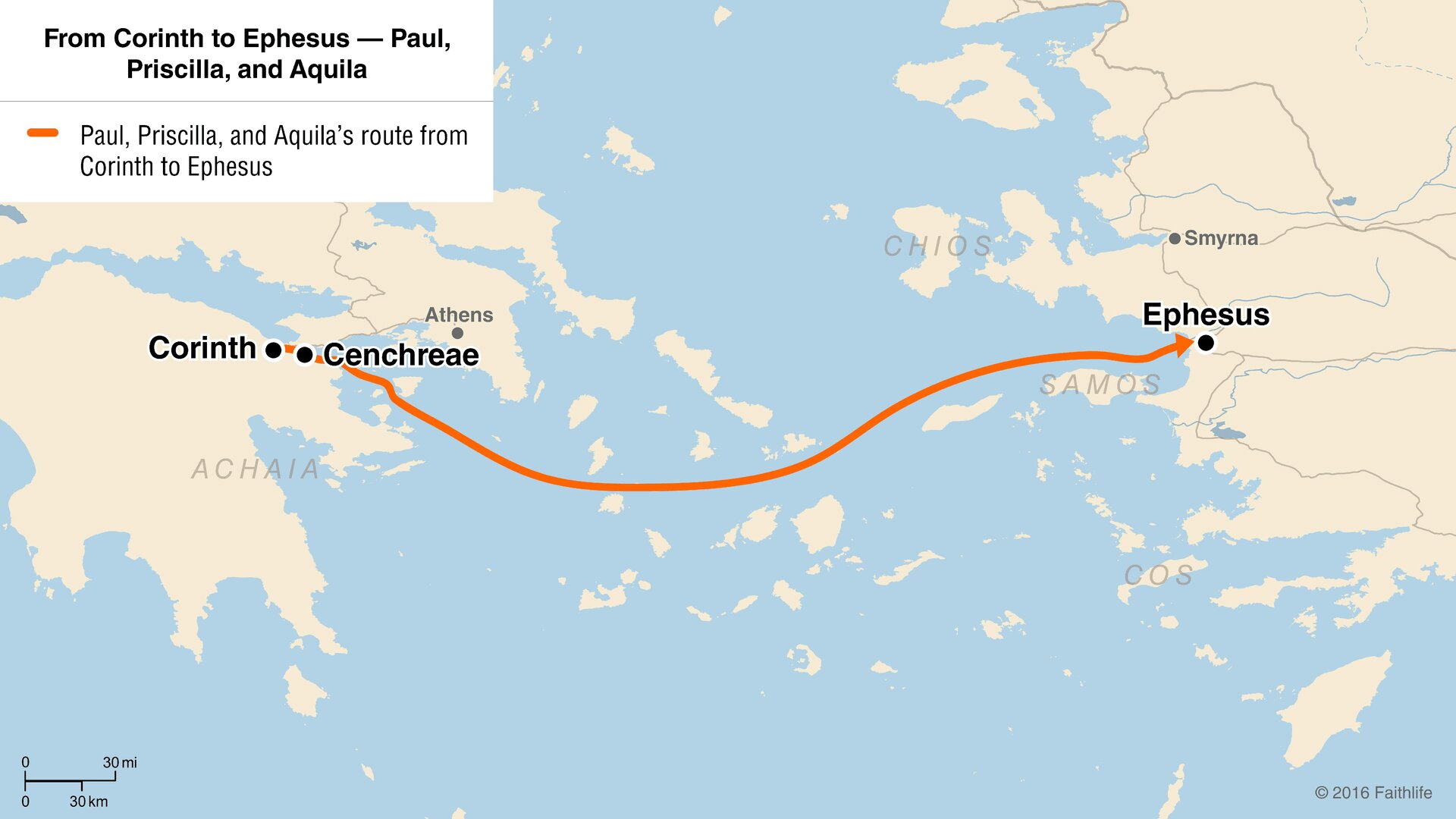
- Vs. 18, We are not told what vow Paul made, although it could have been a Nazarite vow (see Numbers 6.18). Paul clearly still practiced some of his faith according to the Law, but he would not have said that doing so was related to his salvation.
- Vs. 19, Ephesus was the chief city of the province of Asia, boasting a population of ~200,000.
- Vs. 21, Paul had come to understand that his plans were subject to the will of God (see Acts 16.6-7).
- Vs. 23, this would have been the beginning of Paul’s third journey.
Vss. 24-28, Instructing Apollos
- Vs. 24, Alexandria was founded by Alexander in 332 BC. It was perhaps the foremost center of learning in the Roman world.
- Vs. 25, John baptized for the remission of sins (Luke 3.3), but proclaimed that Jesus would “baptize you with the Holy Spirit and fire” (Luke 3.16). Only Jesus would usher in the time when the promised Spirit would be given (Ezekiel 36.25-27), and thus baptism was now for repentance and the forgiveness of sins, but also to receive the promised Spirit (Acts 2.38).
- Vs. 26
- Both husband and wife instructed Apollos, and the mention of Priscilla first may indicate that she took a lead. Yes, women are prohibited from exercising authority over a man (1Timothy 2.12-15) and from teaching in the assembly (1Corinthians 14.34), but to say that they cannot teach a man is simply unscriptural.
- The proper response to doctrinal error isn’t to belittle or argue, but to “explain… the way of God more accurately”.
- Apollos, though an educated and eloquent man, was willing to accept instruction from lowly tent makers. We would all do well to heed his example of taking instruction from whomever has the word of God to share.
- Vs. 27, remember that Corinth was the capital of Achaia. We know that Apollos spent time with these brethren (see 1Corinthians 1.11).
- Vs. 28, Apollos put his great talents to good use (vs. 24)
 Built By Him
Leave a comment