
Throughout history kingdoms have sought to expand. Often their conquests have resulted in the deaths and enslavement of those in conquered territory. But sometimes the conquerors are viewed as liberators. Our study of Acts has seen the Kingdom established and expand through the proclamation of the gospel. But others still needed liberating; they needed the good news to reach them (vs. 9).
Notes From The Text:
Vss. 1-10, The Macedonian Call
- Vs. 1, The name Timothy means “one who honors God.” It is very likely that he, or at least his mother, was converted during the 1st missionary journey (cf. 14.8-23; 2Tim. 3.11). He may have been one of the brothers who witnessed the stoning of Paul. We know that both his mother and grandmother were believers (see 2Timothy 1.5). His faith was spoken of as far away as Iconium, 40 miles to the north of Lystra.
- Vs. 3, “Paul had stoutly resisted circumcision in the case of Titus, a pure Greek (Galatians 2.3, 5), because the whole principle of Gentile liberty was at stake. But Timothy was both Jew and Greek and would continually give offence to the Jews with no advantage to the cause of Gentile freedom. So here for the sake of expediency, “because of the Jews” (dia tous Ioudaious), Paul voluntarily removed this stumbling-block to the ministry of Timothy. Otherwise Timothy could not have been allowed to preach in the synagogues.” (Robertsons Word Pictures)
- Vs. 6, The province of Asia would include cities like Ephesus, Smyrna, and Sardis, large cities with significant populations of Jews. Paul will work in this region at the end of this journey and during the 3rd missionary journey.
- Vs. 7, note that even though Paul was an apostle, this did not mean that the Lord gave him specific details or instructions whenever a choice must be made. Paul intended to preach in these areas, but it was only when he arrived that the Lord made it clear to him that He had other purposes.
- Vs. 10, Note that Luke has joined the party in Troas. He is referred to as the “beloved physician” Col. 4.14. Some speculate that he was from Antioch, others that he was from Philippi. We do not know. He will be present with Paul off and on throughout the remainder of Acts 16.10-17; 20.5-21.25; 27.2-28.16.
Vss. 11-15, The Gospel Spreads To Philippi
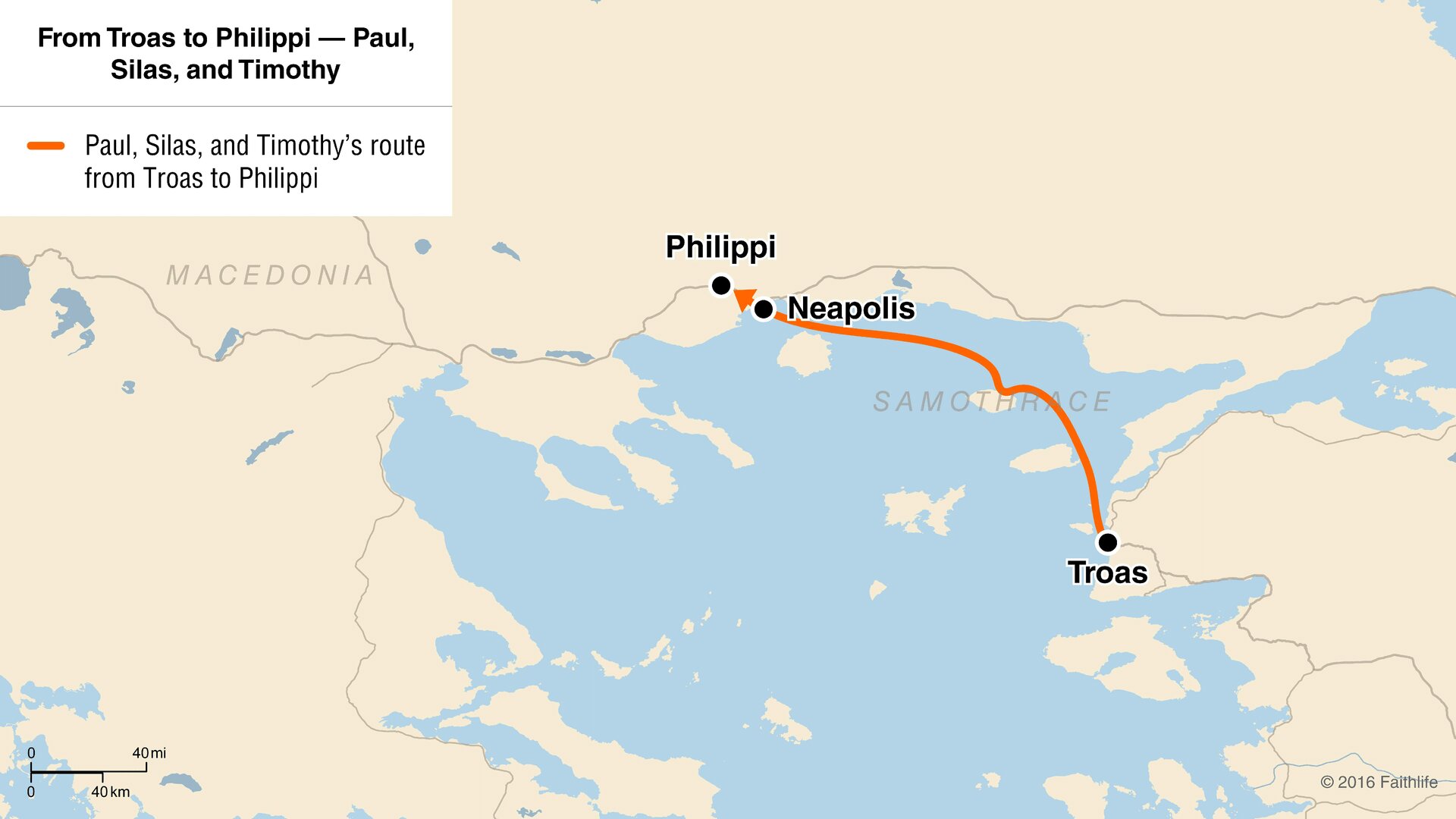
- Vs. 12, Philippi named after Philip of Macedon. Also the site of Octavian’s victory over Brutus and Cassius. For a city to be deemed a colony meant that the rights of Rome were given to that city.
- Vs. 13, The lack of a synagogue would indicate that fewer than 10 Jewish males lived in the city. Bodies of water were common places of prayer since they provided water for ceremonial cleansing.
- Vs. 14,
- Thyatira was in the Roman province of Asia, so in the very area where Paul had been forbidden to proclaim the gospel (vs. 6).
- Purple was an extremely valuable dye. It took ~8000 mollusks to produce one gram of the dye.
- “Worshiper of God” would place her in the same category as Cornelius (Acts 10.2).
- “opened her heart”, “i.e., she understood the significance of the message (cf. Lk. 24.45; Acts 26.18) …The order of occurrence in the events is crucial. Calvinism asserts that one cannot give an honest hearing to the gospel until after the Lord has opened the heart by means of a direct operation of the Spirit. In this case, though, Lydia first willingly heard, and her heart was opened thereby…Note how giving heed is used in contrast to disobedience elsewhere in the New Testament (Heb. 2.1-2).”
- Vs. 15, not only would blood relatives be part of a household, but also servants and slaves. Those wishing to justify the practice of infant baptism appeal to this passage. However, the text in no way intimates that there were any infants in Lydia’s household. The necessity of belief for salvation (see vs. 31) eliminates the possibility of infants being baptized.
Vss. 16-24, Paul & Silas Imprisoned
- Vs. 16, “a spirit of divination”, “Lit., a spirit, a Python. Python, in the Greek mythology, was the serpent which guarded Delphi. According to the legend, as related in the Homeric hymn, Apollo descended from Olympus in order to select a site for his shrine and oracle. Having fixed upon a spot on the southern side of Mount Parnassus, he found it guarded by a vast and terrific serpent, which he slew with an arrow, and suffered its body to rot (puqei√n) in the sun. Hence the name of the serpent Python (rotting); Pytho, the name of the place, and the epithet Pythian, applied to Apollo. The name Python was subsequently used to denote a prophetic demon” (Vincent)
- Vs. 17, note how demons also proclaimed the truth about Jesus (see Matthew 8.29; Mark 1.24; 3.11).
- Vs. 18, the power of God is greater than the power of Satan or of any demon (see 1John 4.4).
- Vs. 19, the phrase “was gone” is the same Greek as translated “came out” in vs. 18. The spirit was now gone from the slave girl, but all her owners could see was that their profits were gone.
- Vs. 20, Jews and then Christians were assailed as “atheists” because they believed in one God rather than a pantheon of gods. Casting out a spirit associated with Apollo would be seen as an attack on popular religion.
- Vs. 22, Paul would later recount this beating, 1Thess. 2:2 cf. 2Cor. 11:25. Romans were not bound to the Jewish law of 40 stripes. Significantly, Roman citizens were not allowed to be beaten (vs. 37).
Vss. 25-40, Conversion Of The Philippian Jailer
- Vs. 26, “It is hardly relevant to comment that this region was known for earthquakes. This was a providentially directed, highly selective quake. It involved precise timing and a specialized focus. The roof did not cave in; the walls did not crumble. The effect simply was to free the prisoners – doors unlocked, bands off! And yet there was not the slightest injury to anyone. Truly amazing.” (Wayne Jackson)
- Vs. 27, Roman law required the death of one who allowed prisoners to escape.
- Vss. 31-33, salvation is truly for those who believe in Jesus (see John 3.16). But in order to believe in Jesus, one must hear the good news about Him (vs. 32). And if one truly believes in Jesus, he will obey His commands without hesitating (vs. 33).
- Vs. 37, “The apostle’s demand was not merely a question of pride; rather, it doubtless was for the benefit of the new congregation that would be left behind as Paul, Silas, and Timothy would soon move on.” (Wayne Jackson)
 Built By Him
Leave a comment