
“and you will be My witnesses in Jerusalem and in all Judea and Samaria, and to the end of the earth.” (Acts 1.8 ESV) Chapter 13 begins the fulfillment of the third part of Jesus’ plan: spreading the gospel to the end of the earth. Luke prepared us for this moment by recording the conversion of Saul (Acts 9) the spread of the gospel to the Gentiles (Acts 10) and the work of Barnabas in Saul in Antioch (Acts 11,19-30; 12.25). Paul/Saul will be the primary focus of Acts 13-28 as he takes the gospel through much of the known world.
Notes From The Text
Vss. 1-3, Barnabas And Saul Set Apart
- Vs. 1, “Manaen a lifelong friend of Herod the tetrarch” This was the same man who beheaded John the Baptist (Luke 9.7-9) and mocked Jesus (Luke 23.8-12). He, who was once a lifelong friend of a butcher, was now “brother” to the King of Kings!
- Vs. 2, see Acts 9.15. The Lord revealed to Saul at his conversion the work he would be called to do.
Vss. 4-12, On The Island Of Cyprus
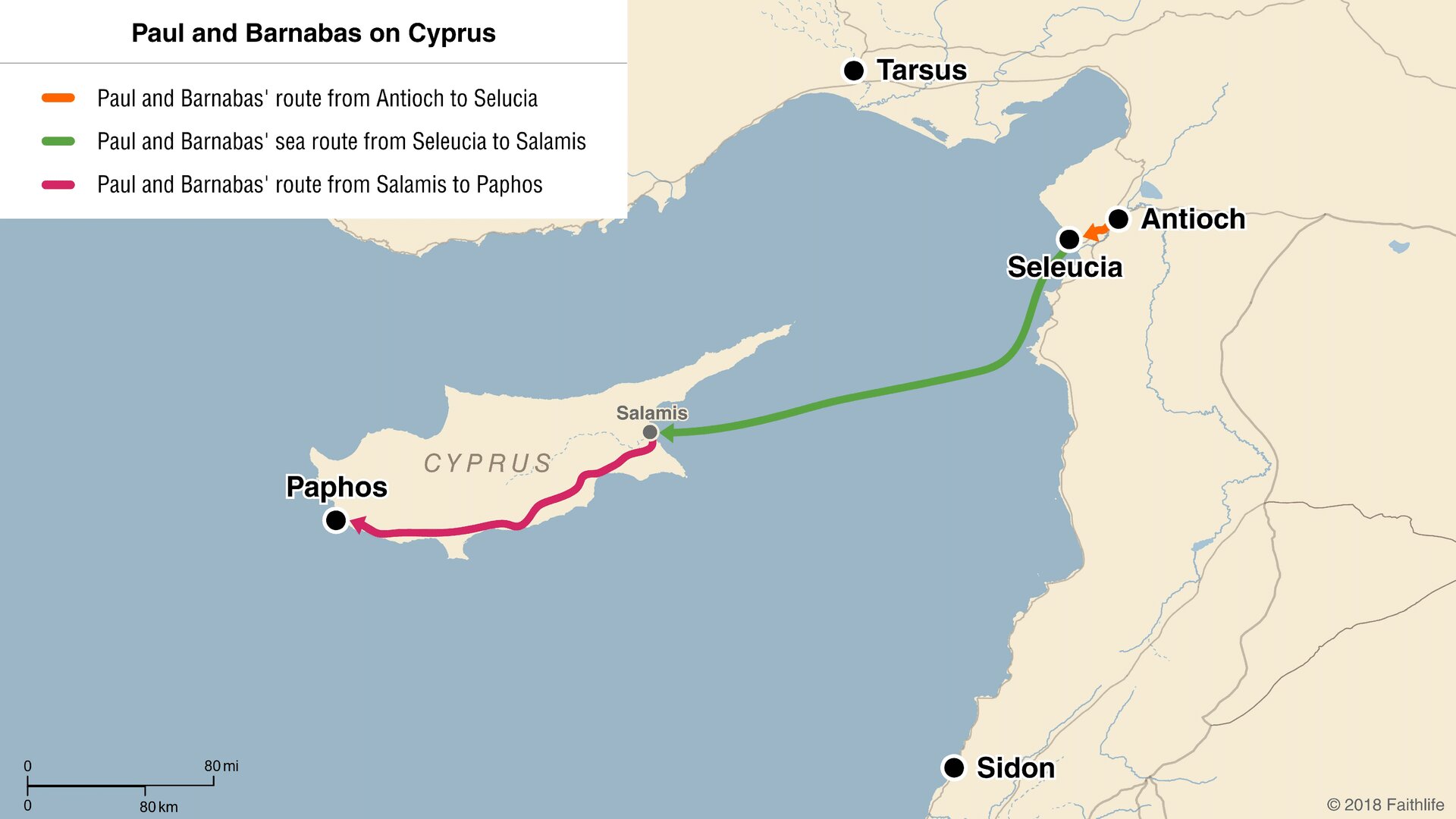
- Vs. 4
- Seleucia was the seaport of Syrian Antioch.
- Cyprus: the homeland of Barnabas (see Acts 4.36).
- Vs. 5
- We will see that Saul/Paul made a habit of first preaching in the synagogues wherever he journeyed. While the gospel was to “the Jew first” (Romans 1.16), the synagogue would also provide Paul opportunities to read God-fearing Gentiles.
- John’s role as “assistant” may very well have involved helping with menial tasks, but very likely included his preaching and perhaps sharing eyewitness testimony (note that the same word is found in Luke 1.2).
- Vs. 6
- Paphos was the headquarters of Roman rule on the island of Cyprus.
- “magician” = magus, the same word used to describe the “wise men” from the East in Matthew 2. “Bar-Jesus” simply means “son of Jesus/Joshua”.
- Vs. 7, the Roman governor (proconsul) was described as a man of intelligence. He was intelligent enough to know truth when he finally heard it from Saul and Barnabas. So, he “sought to hear the word of God.”
- Vs. 9, “It was customary to have a given name, in this case Saul (designating a Hebrew with a Jewish background), and a later name, in this case Paul (denoting a Roman with a Hellenistic background).” (Archaeological Study Bible)
- Vs. 10
- “you son of the devil” recall that Jesus had also referenced the spiritual heritage of his opponents (see John 8.44).
- “will you not stop making crooked the straight paths of the Lord?” Contrast with Malachi 3:1. Elymas was seeking to make it more difficult to follow the Lord. What a sad comment that is true of many who claim to be teachers of the Lord.
- Vs. 11, “The teacher who had led so many into darkness now himself wandered around, trying to find someone to lead him by the hand.” (Wayne Jackson)
- Vs. 12, The miracle had the intended effect! Sergius Paulus, when he saw the miracle, could only believe the amazing truth of God being delivered by Paul and Barnabas. (see Mark 16.20; Heb. 2.3-4)
Vss. 13-52, At Pisidian Antioch
- Vs. 13, We are not told why John left, but we do know that Paul was upset by it and it was the source of a later dispute between Paul and Barnabas (see Acts 15.37-40).
- Vs. 14, the trip from Perga to Antioch was ~100 miles and required trekking over the Taurus mountains. The road was notoriously dangerous, frequently harried by robbers (cf. 2Corinthians 11.26).
- Vs. 16, “you who fear God” referenced Gentiles who were attracted to Judaism.
- Vss. 17-41, Paul’s sermon at Antioch is one of the longest we have recorded from the apostle. His main points are as follows:
- Jesus is the fulfillment of God’s dealings with Israel (vss. 17-26).
- The Jews rejected Jesus, but ultimately fulfilled God’s purpose (vss. 27-29).
- God fulfilled His promise to the fathers by raising Jesus from the dead (vss. 30-37).
- Forgiveness and justification, which the Law could not provide, are available to all who believe in Jesus (vss. 38-39).
- Beware lest you reject God’s promise (vss. 40-41).
- Vs. 20, “The most common view currently is that this span includes about 400 years in Egypt, forty in the wilderness, and some ten years in the conquest of Canaan.” (Wayne Jackson)
- Vs. 22, see Psalm 89.20-21; 1Samuel 13.14.
- Vs. 23, the promise of the coming Messiah is throughout the Old Testament (see Gen. 3.15; 12.3; II Samuel 7.12; Isaiah 11.1; etc.)
- Vs. 33, see Psalm 2.7.
- Vs. 34, see Isaiah 55.3.
- Vs. 35, see Psalm 16.10.
- Vs. 40, see Habakkuk 1.5. “As punishment came ultimately upon the Hebrews in the form of the Babylonian captivity, so similarly God’s wrath finally will be visited upon those who reject the gospel. A temporal punishment cam upon the Jews in A.D. 70, with the Roman invasion of Palestine; an ultimate judgment will occur at the second coming of Christ.” (Wayne Jackson)
- Vs. 43, why would anyone need to be urged “to continue in the grace of God” if grace is irresistible as some teach?
- Vs. 46, note that by rejecting the gospel one judges himself “unworthy of eternal life”. God does not predestine us to either salvation or condemnation; we choose for ourselves.
- Vs. 47, see Isaiah 49.6.
- Vs. 48, Recall that the Jews had thrust the word aside, and thus judged themselves unworthy of eternal life (vs. 46). The opposite occurs here: they glorify the word of the Lord and were thus “appointed to eternal life”.
- Vs. 51, see Luke 9.5. Iconium was ~75 miles from Antioch.
 Built By Him
Leave a comment